Personal Thanks on Detroit Newspapers Independence Day
On the occasion of independence day for both the Detroit Free Press and Detroit News as their JOA expires, I thought it appropriate to relate how my three-year stint at the latter turned a longtime broadcast guy into the reporter I never really got to be standing in front of a camera.
My long broadcasting career came to a sudden halt in January, 2001 when I was laid off from CNN, along with about 1,000 others as a result of that awesome merger between parent company Time Warner and AOL.
My family liked living in Michigan, even though my wife and I were native New Yorkers and both our kids were born in Atlanta. I thought the local TV stations would be open to hiring an ex-network guy. Not so.
I wasn’t flashy enough. CNN reporters didn’t do a lot of consultant-certified “reporter involvement” shtick and an agent said there was “no interest.”
In fact, in an interview with one news director I was told “we don’t want journalists, we want street characters, like they have at the stations in New York City.”
OK. Broadcast career done, but I still needed to make a living.
Thankfully the Associated Press Detroit bureau chief, Charles Hill, saw my resume on the Journalism Jobs website and contacted me about the national auto writer position.
I had to take a writing test and go through two lunches and interviews before Charles decided to take a chance that a TV guy could handle a very demanding and competitive print beat.
There was a definite learning curve and our news editor Randi Berris and supervisor Mike Householder were patient and instructive in guiding me through the transition.
I missed TV but as I locked onto the longer-form of print I reveled in being able to use many more words—even big ones! I loved having the time to develop stories and not crashing a two-minute broadcast package to make a satellite feed.
A little over a year into my time at the AP, I got a call from then Detroit News autos editor David Phillips asking if I was interested in an opening at the paper as the General Motors beat writer.
I jumped at it, even though I’d never worked at a paper before. When I mentioned that fact during my interview, I was told, “don’t worry about how the paper works. Just write great stuff and we’ll do the rest.”
My first assignment was to write a 36-inch story on the 100th anniversary of Cadillac. I really didn’t have any concept about how long a story that really was and sweated that I’d never get it done that day.
Ha! First new lesson about working at a paper. My deadline was not 5 p.m. that day, a Monday, but 5 p.m. on freakin’ Thursday! In my past life at CNN and the AP I would have written at least five stories in that time, maybe more.
But it didn’t take long before I was faced with some new realities that I did not handle very well. In TV, especially at CNN with strict editorial standards, our scripts were reviewed and closely edited before reporters recorded their narration. Our copy editors were properly persnickety, but given the tight deadlines the process was fairly quick.
Once the story was edited and fed to Atlanta for air, that was it. You always knew how the story would look on the air because there could be no further changes.
Not so in newspaper-land. One day I came into the office and my message light was flashing. It was a pissed-off voice mail from a PR guy at GM. Something in the story angered him. It angered me too, because it wasn’t what I wrote. An editor decided to play around with the story after I left for the day and changed the tone and meaning of the original sentence.
It wasn’t factually wrong, requiring a correction, but it was misleading. When I protested to the editor I was told he was just “cleaning up the language.”
Hmm.
Other times, when I thought I had come up with brilliant word play or sentence construction, I’d find it revised by an editor who didn’t think it was either brilliant or appropriate.
I whined about this to one of my co-workers who became my valued mentor, the very experienced and brilliant Christine Tierney, who looked me in the eye, and in no uncertain terms set me straight.
“This is called editing,” she scolded me. “It’s part of the process and we’re all subject to it so knock it off.”
Got it.
I actually loved working at a newspaper and took so much pride in seeing my stories and byline on the front page at times and knowing they weren’t some ephemeral thing disappearing into the ozone.
I loved having the time to build relationships, break stories, having the opportunity to dig in and write stories with substance.
I also loved newspaper people—tough, quirky, brilliant, hilarious, and unlike my former TV colleagues, didn’t spend a lot of time in front of a mirror.
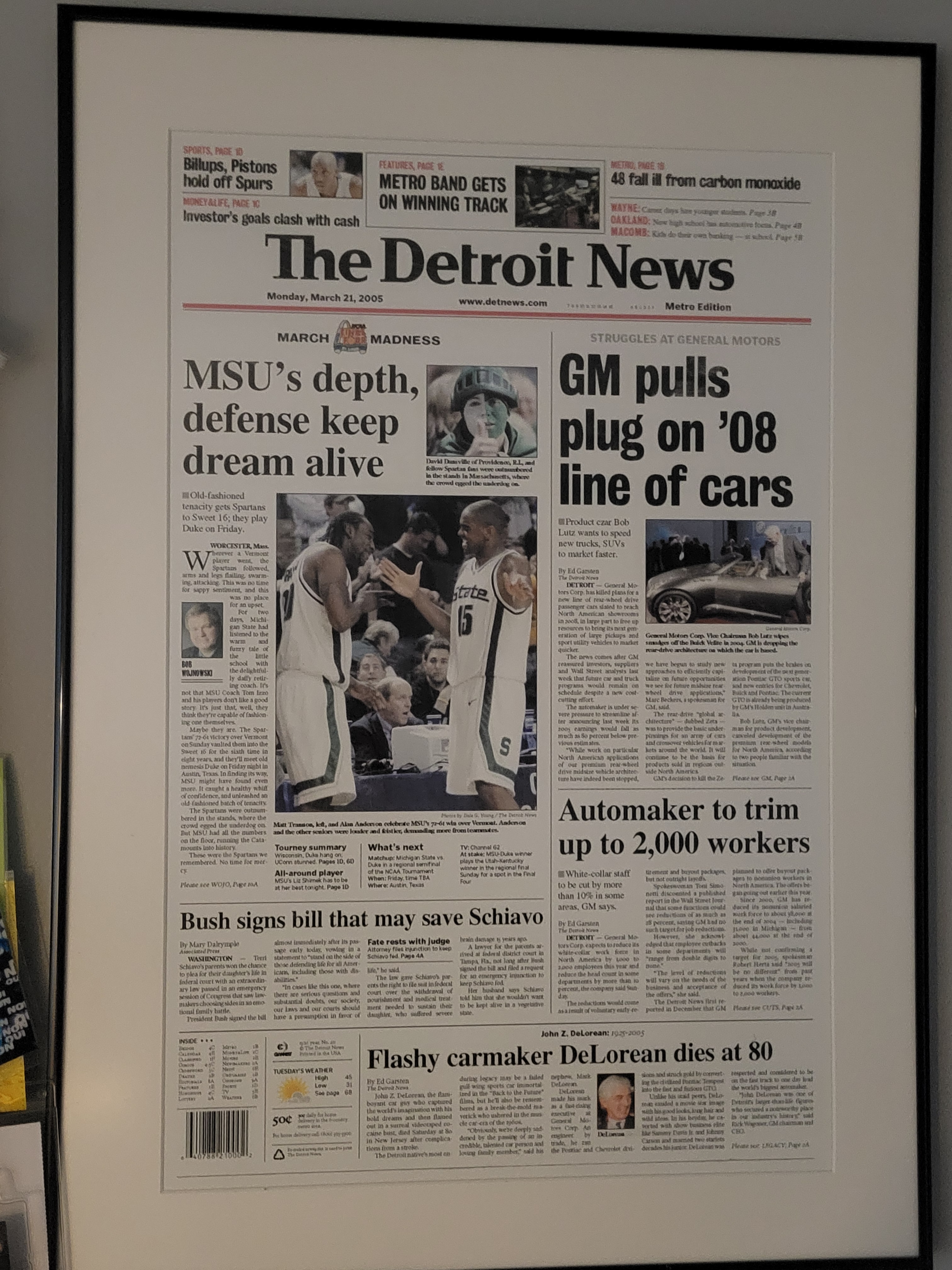
My highlight at the Detroit News was landing three page one bylined stories I in the same edition. The managing editor awarded me a framed copy of the page and told me it was only the third time that feat had been accomplished since the 1930’s.
What made it an even bigger feat, for me, anyway, was that one of those stories was written while I was prepping for a colonoscopy. Hey..breaking story.
I worked at the Detroit News for three years to the day, from August 23, 2002-August 23, 2005, when I left to accept the intriguing position to manage and write then, DaimlerChrysler’s first blog.
I stayed at the automaker through its changes for 11 years until I retired in 2016 as head of its digital communications team.
In my semi-retirement I’ve been writing mobility stories for Forbes.com.
But I credit my brief time at the AP, and longer time at the Detroit News for giving me the experience, confidence and education to successfully make the transition from broadcast to broadsheet to web.
I do miss the format of TV news at times, but those days are long passed. It’s mainly live shots and one-man band crews where the reporter is also the shooter and editor and my ego doesn’t require that sort of satisfaction.
I’m perfectly satisfied crafting stories with words and facts and sparing the public my aging puss.
But hell, I still carry a little powder in my go-bag. Ya never know when a lens is lurking.
I know print editions of newspapers are an endangered species, giving way to online delivery. Yes, it’ll be sad when I can’t spread my morning paper out while I’m slurping my Cheerios but what really matters is the reporting and public service.
We need newspapers in any format and I sincerely hope our two newly independent papers here in Detroit flourish and continue to bring us their great reporting for many years to come.
 edLINES
How did your transition from broadcast journalism to print reporting at the Detroit News reshape your identity as a journalist after leaving CNN?
LikeLike
I actually made the transition from broadcast to print at the Associated Press right after CNN. The editors there was very kind, instructive and patient in helping me make the transition. I actually grew to prefer print, having the ability to concentrate on the words and story structure, without having to be concerned about being on-camera.
LikeLike