Category: Uncategorized
Chrysler’s Sad Love Life

Marriage can be an iffy thing. Especially if you’re an auto company that can’t seem to exist without being coupled, sometimes with a parasite. That’s what the entity commonly just called Chrysler seems to be.
Full disclosure—I worked at the company for 11 years through three of its marriages. One ended in divorce, another as a result of bankruptcy and a third where Chrysler just became the second of its combined name.
I retired in 2016, five years before the company was sucked into another relationship and lost its identity altogether, as part of a blob of corporate Play-doh called Stellantis.
Keep in mind the last three letters in Stellantis are also the final three letters in the suffix “it is” which is a medical term for some sort of inflammation. Appropriate, since the CEO just flamed out and flew the coop with a nice multi-million dollar nest egg.
So this seems like a good time to examine Chrysler’s marriages from both my inside perspective and a more macro view to better understand how this corporate Sadie Hawkins should go about chasing its next partner—or should it?
In 1998 the all-American Chrysler Corp. was joined in a shotgun marriage to the German automaker Daimler AG. It was billed as a “merger of equals.” There should have been a pre-nup. There was nothing equal about the marriage. The Germans were clearly in charge.
I joined the DaimlerChrysler in 2005 as a contractor—hired to ghost write and manage the company’s first corporate communications blog. A year later, having been a broadcast and print journalist since 1973 and covering autos since 1989, a new digital communications team was created around me. I was hired on staff to run it.
My boss at the time sent me to attend the annual “communicators conference” at DCX headquarters in Stuttgart, Germany. To get there I was granted a seat on the company’s plush jet.
Somewhere over the Atlantic I received some valuable insight as to how the Chrysler side of the marriage was regarded. I overheard a couple of engineers complaining that “they want us to build Chrysler vehicles with Mercedes quality on a Chrysler budget—impossible!” Yes, it was.
During the actual meeting, a German executive declared any quality issues should be blamed on Chrysler—and welcome to Stuttgart. Ach!
Some marriage. Even the late Dr. Ruth Westheimer couldn’t fix that relationship.
On Valentines Day 2007 the Germans decided to ditch their American spouse with little warning. At the “annual news conference,” held for the first time at Chrysler headquarters in Auburn Hills, Michigan, CEO Dieter Zetsche spilled that all options were open with regard to the future of the tenuous tie-up. By summer the divorce was final and Chrysler found itself in a new abusive relationship—this time with capital management company Cerberus—yes, the three-headed dog guarding the gates of hell.
The upside was the company went back to being just Chrysler. The downside was everything else. Cerberus was known as a corporate slum lord and the new CEO, Robert Nardelli, known for being passed up as successor to General Electric boss, Jack Welch and for being fired from Home Depot after its stock tanked as a result of his bad decisions.
Cerberus had no experience running an auto company and it showed. Its main strategy was simply firing people. I watched as dozens of my immediate co-workers and hundreds more were suddenly told to grab a box, fill it with their stuff and take a hike.
There was a guy installed in one of the little glass offices on our floor who spent his days hovering over a computer and transferring figures to a white board with the mission of plotting where, and whom, to cut.
At one point, to make the world think the company was actually doing something constructive, the company decided to invite the automotive media, along with CNBC’s auto reporter, to anchor live coverage from our headquarters of the unveiling of a line of “production intent” electric and extended-range vehicles under the acronym, ENVI..the first letters of the word, “environment.”
There were three ENVI vehicles–a coupe based on a Lotus that went by the name Dodge Circuit, and two others based on a Jeep Wrangler and Chrysler Town and Country minivan. Coverage was massive.
In fact, the CNBC reporter called me a few weeks later to say if I could get the Dodge Circuit to New York City by that Thursday, he could get it on the Today show along with the Chevrolet Volt.
No problem. I flew out to NYC for the show and was both heartened and horrified when Today host Matt Lauer said to the CNBC reporter he liked the Volt but if given the choice, he’d go for the Dodge. See the segment here. Sorry in advance for the rough quality.
Cerberus said the ENVI vehicles would go into production by 2010 but they never did.
Greatly summarizing here, the combination of the recession and the company going into bankruptcy, along with General Motors Co., buoyed by federal government bailouts, led to Cerberus exiting and Fiat S.p.A. at first taking a partial stake in Chrysler with Fiat CEO Sergio Marchionne leading both automakers.
Requiem For An Idea

This is an obituary for an idea that sprang from momentary consternation, lasted 17 years, won awards and respect and recently died a quiet, undignified death.
It was September, 2007, a month after corporate slum lord Cerberus took over Chrysler from merger of unequals Daimler. My job was head of the company’s digital communications team, which included its media website, social media, broadcast media relations and video production.
Since all news releases issued by the company came through my team to be posted on the special website for media, I knew everything we were putting out there in hopes of winning coverage.
The truth is, earned media, as it’s known today, is a crapshoot. You post and pray, and most times whomever you’re praying to treats you like an atheist.
So one day I was looking over some recent releases that were posted to the media site and realized there were several that earned little to no media at all. As a journalist-turned PR guy, I knew these items would languish for lack of major news, but as a company employee I also knew the item was important to someone, probably an executive, who was banking on seeing some daylight for his or her little bit of news.
If you’re familiar with the process of creating a news release and related assets, you know a lot of work goes into it—writing, editing, approvals, re-editing, re-approvals…..miles of red tape.
This bothered me.
So in the course of literally a moment, I thought, what if we created a weekly video recap of Chrysler news that included some of those ignored items? It would give those stories another chance to reach an audience instead of just languishing and going nowhere.
Chrysler’s main logo at the time was the Pentastar, and there was a big pentastar-shaped window on the top floor of our Auburn Hills, Michigan headquarters.
So I titled the recap “Under the Pentastar.”
My bosses instantly approved going forward, but with zero budget.
No problem. I posed the idea to my team but told them we’d all just have to pitch in on a volunteer basis to produce the feature every week. OK, they said!
A signup sheet was posted and it didn’t take long for it to be filled with volunteers, including myself.
We posted what we called “UTP” on the media website, YouTube and our social media channels.
It took awhile but it slowly gained an audience. Those of us who narrated UTP became known and even had followers.
One member of my team, the wonderful Betty Carrier Newman, was a former anchor at WDIV in Detroit. Has a great voice. In fact, our boss nicknamed her “The Voice” long before the cheesy singing show.
Betty had her fans who looked forward to listening to her golden pipes.
As a former radio announcer and network news correspondent, I’d record some of the narrations as well.
One year, at the Los Angeles Auto Show I introduced myself to a worker setting up our stand. Now remember, I was on the air at CNN for almost 20 years. But when I told him my name, he said, “Ed Garsten…From Under the Pentastar! I listen every week..love it!”
That’s when it hit me we’d really done something worthwhile.
UTP won an award from the International Association of Business Communicators (IABC) and maybe another. Can’t remember. It was more important that we’d won an appreciative audience.
When Fiat took over the company in 2009 and later changed the name to Fiat Chrysler Automobiles, (FCA) the Pentastar logo was discontinued. “Under the Pentastar” became “FCA Replay.”
Our new Italian bosses absolutely loved it and referred to it often in reverent terms.
All this time, the weekly video news recap was produced by team members who continued to sign up to write, produce, narrate it above and beyond their actual duties.
It was never slick the way an actual agency or production house might handle it, but we did our best with limited resources and it always looked at least professional.
After I retired from FCA in 2016 and the company was later taken over by the French, a new company was created called Stellantis. The team members I left behind changed the feature’s name again, accordingly, to “Stellantis Spotlight.”
All this time, our two video editors/producers, Paul Cirenese and Peter Spezia kept it going. Never missing a week. I don’t know if I ever properly expressed how much their devotion meant to me. They’re two of the most solid souls I’ve ever been privileged to work with, along with Betty Newman and our incomparable media site manager Courtney Protz-Sanders.
In recent years I would only occasionally view Stellantis Spotlight as my life in retirement took on its own life. But I would check in periodically.
It had been a couple of months since I did when this week I noted there were no episodes after September 27th. The episode is below.
As a freelance auto reporter for Forbes.com I was well aware of the cutbacks and job losses at Stellantis and suspected “Stellantis Spotlight” fell to the budget ax, which is troubling, since it operated with no budget.
A few days ago I spoke to one of my former teammates about it.
Knowing it was something I still held dear she gravely informed me my suspicions were correct.
After more than 800 episodes over 17 years, under three different titles, our award-winning little weekly video recap created in a moment’s thought and kept alive by the power of devotion, just ended without ceremony.
Look, as trite as it sounds, nothing lasts forever, especially in the corporate world. But for the rest of my life, I will always be thankful for my dedicated team for embracing, then giving life to an idea borne in a moment’s thought, simply to give overlooked stories a second chance of being noticed.
Ghost in the Hell–A Workplace Horror Story

Unlike retail stores that show their Halloween stuff in July, I waited until now to conjure up a little verbal potion of apparitions that manifest themselves in the form of untalented and cowardly managers and executives.
You see, they don’t wait for All Hallow’s Eve to dress up as ghosts—they play the role all year long.
Just like all ineffective bosses are not alike, there are various methods employed by the bottom-feeders who would rather lurk as passive-aggressive cowards than have the courage to appear before their charges and reveal their actual frightening thoughts.
Ah..but isn’t Halloween all about fright? There’s a difference between being scary and not having the intestinal fortitude to scare up honest feedback.
Yes..it’s an exercise in the dark arts—keeping employees in the dark about where they stand, the quality of their work, the chances of promotion or raise.
I’ve worked long enough to have been ghosted by several bosses. One day you’re in the “house,” having regular conversations and interplay with the person to whom you report. Then one day that house becomes haunted when that person metamorphosizes into a being never seen, never heard, acting as if you never existed.
You’re spooked.
The questions fly through your brain. Is the boss mad at me? Am I getting fired? What’s going on?
Then you make the mistake of approaching the body with no substance looking for answers. The replies you receive are as transparent as the ghost boss’s soul.
You can hear him or her now conjuring the lies they are about to tell you. Hovering over a cauldron of steaming bullshit, they stir it while chanting the ingredients they are adding.
“A gallon of lies! A dash of mis-direction! A pair of side eyes! A dollop of deceit!”
Then they serve it up expecting you to swallow…and believe.
That’s the time to politely explain you’re already up to here with crap and tender your notice.
When the dispirited spirit attempts to reverse your resolve, you turn to the empty vessel and calmly reply, “Not a fucking ghost of a chance.”
Trick and retreat.
I Hope Trump Was Right About Detroit

I hope Donald Trump was right when he thought he was insulting Detroit, while speaking here, predicting if Kamala Harris beats him in the presidential election, declaring, “Our whole country will end up being like Detroit if she’s your president.”
I hope he’s right. Harris should hope so too, and campaign on that hope.
My love affair with the Motor City began in 1989, although it wasn’t love at first sight.
After eight years working at CNN at its Atlanta, Georgia headquarters launching Headline News, producing thousands of news casts, being promoted to correspondent and anchor, it was time for a change.
That change came when CNN Detroit’s first bureau chief/reporter, the inimitable Robert Vito, was appointed to lead the network’s bureau in Rome.
Few people wanted to take his place because Detroit was, y’know, a scary, cold, murderous, nasty place. At least that was its reputation.
I’m a native New Yorker. That kind of stuff doesn’t deter me. So I applied for the job and got it.
In the weeks before I made the move, idiots in the newsroom gave me shit warning me to buy an Uzi and other small arms with which to defend my kith and kin.
But there were also a couple of folks who actually had lived and worked in Detroit and told me to ignore the morons, one predicting, “once you live there you’re never gonna wanna leave. Just give it time and explore.”
When I asked why they left, they both said it was simply a matter of seizing career opportunities but they missed the place badly and visited often.
So we moved. It wasn’t great at first. We went from a split-level house that eventually took us nine months to sell because the Atlanta market was over-built, to a rental townhouse in suburban Farmington Hills that had plenty of room but lots of, um, rodents and at least one hooker as a neighbor.
It was colder, more cloudy and at the time Detroit’s downtown was fairly run down. But I kept remembering what those folks told me about giving it time and exploring. So we did.
As the new Detroit bureau chief and correspondent my prime coverage responsibility would be, of course, the auto industry.
CNN founder Ted Turner said he established the Detroit Bureau in 1983 because he wanted to be close to the most important industry in the world. The bureau was also in the basement of PBS station WTVS a couple of blocks from the old General Motors headquarters in Detroit’s New Center area. Again, Turner put it there because he wanted CNN’s Detroit Bureau to be near the biggest company in the most important industry in the world.
I quickly found out something perhaps Turner didn’t know about Detroit and the auto industry—how warm and welcoming both could be, especially if you showed some humility and a willingness to learn, which I did.
My new charges at the bureau instantly made me feel welcomed and were kind enough to drive me around the area as I considered places to live and explained the mile road system.
Now don’t get that confused with the “southern charm” I was used to in Georgia. Let’s just say Detroit has its own vernacular—meaning a directness that one could mistake denotes rudeness.
Example. My first real contact with the auto industry was interviewing the top numbers cruncher for Ford. He was a crusty guy two months from his retirement. When I sat down to begin the interview he barked at me, “okay, you’re new, you don’t know anything. Just shut the hell up, listen to what I say and get it right.”
I did on all accounts and after my story aired he called me, now speaking in a much friendlier tone and laughed, saying, “scared the shit out of you, didn’t I? But you did real good. Welcome to Detroit.”
Yes. I needed to give Detroit a chance.
After that I was invited to attend and to speak at a number of events where industry and PR poohbahs gave me warm welcomes.
I was even invited, several times, to appear on the radio with legendary WJR morning giant, the late J.P. McCarthy, where he’d give me gentle shit about the media bashing Detroit. I won him over by changing the subject, telling him anecdotes about Ted Turner sometimes appearing the Atlanta newsroom in a bathrobe after spending the night in his office upstairs after a particularly rough evening of, er, personal enjoyment.
I was honored to be one of McCarty’s final guests on his Focus segment the week of his last shows before he retired.
Over the years my family and I discovered the beautiful suburbs, the wonders of Michigan and above all, the friendliness of its people. We also reveled in the genius of the hard-working citizens who constantly push the boundaries of technology, mobility, education and culture.
In January, 2001 CNN’s parent company completed what would end up being a disastrous merger with AOL, and the company closed bureaus and laid off about a thousand of us in one fell swoop. I was one of them.
So now a choice had to be made. Where to go to continue to make a living. Our two kids were still in school and we very much wanted to avoid uprooting them.
But in the end it wasn’t really a question of moving. My family said they love it here. The Detroit area has everything you could want—schools, shopping, recreation, culture, major league sports teams. Why move?
There weren’t any TV jobs for me so I re-invented myself as a print reporter. Again, Detroit came through for me.
The Associated Press Detroit bureau chief Charles Hill needed a national auto writer and I had place my resume on a journalism job website. He was skeptical a TV guy could actually write—typical bias against broadcast journalists—but gave me a chance.
Yes, there was a learning curve, but again, Detroit came through for me. My editor, Randi Berris and supervisor, Mike Householder, held my hand, broke me of some TV habits and were so, so patient and supportive.
It led to being recruited by The Detroit News to be the General Motors beat writer and three years later, tapped by then DaimlerChrysler PR chief Jason Vines to ghost write and manage his new blog. That job eventually grew to the creation of a new digital communications team which I was appointed to lead until I retired in 2016.
Even after I retired, the opportunities kept coming. I was recruited to use my many years of broadcast journalism experience to help out the Automotive News with its twice-daily newscasts.
That ran its course and I was immediately approached by a former Chrysler colleague at Franco PR to work as a consultant and at the same time, the Forbes Detroit bureau chief asked me if I’d like to be a freelance automotive contributor. That was in 2018 and I’m still working those two part-time gigs, which I thoroughly enjoy.
You see a theme here? Detroit represents open-mindedness, opportunity, fulfillment. My kids are adults but they’re still here. We didn’t skip town upon retirement. Indeed we bought a bigger house.
We live exactly one minute from a magnificent trail that connects with others for many, many miles where we often walk or bike ride.
We’re surrounded by lakes and are only 20 minutes from the Huron River where I often paddle in my kayak.
My daughter and boyfriend have also recently introduced me to the magnificent sport of disc golf. Who knew there were so many wonderful courses in the Detroit area—most of which charge no fee?
Detroit has become internationally renowned for its eclectic restaurant scene with restaurants led by adventurous chefs conjuring meals and experiences delighting diners with tastes that range from basic American fried stuff to gourmet dishes delving into an array of elements and cultures.
Thousands of new homes, apartments, townhouses and condos are opening or under construction, aimed at attracting new full-time residents to the city.
Take a look at Detroit’s skyline. That new Hudsons block skyscraper is a metaphor for the new heights our town is reaching.
Leave the Detroit area, leave Michigan? Are you freakin’ crazy?
So listen, Kamala Harris. If you become President of the United States, you would do well to make much of the country a lot like Detroit. And Trump? You were too stupid to know the insult you intended was actually a compliment.
Simplifying Self-Help

Do you rely on so-called “self-help” books to improve whatever it is you want to improve? About eight years ago I wrote about why I don’t think much of them and my unexpected reply to a college student who asked me following a speech I gave, what self-help book I would recommend to improve relationships with co-workers. It’s in the blog post to which I’ve linked.
Lately I started thinking about self-help books again for a couple of reasons. For one, while in a book store, I noticed they’re not called “self-help” books anymore, but rather less obtuse categories such as “self-improvement” or “life-improvement.”
Do those alternative categories soften the realization that one might need actual help in some area of their lives? If so, why is that necessary? There’s no shame in seeking help and we can all certainly stand to improve.
But it falls under a growing trend de-sensitize the truth. It sounds kinda harsh to say we need “help,” and clothing for larger folks is no longer labeled “plus sizes” but rather “comfort fit.” That’s fine. Self-esteem is important and I take no issue with attempts to help individuals feel better about themselves.
That leads to my main point. Self-help, or self-improvement, whichever you prefer, is much simpler than the myriad books and magazine articles make it seem. There’s no need to fill hundreds of pages with many thousands of words.
Self-help can be as simple as self-control. See? Two words.
Let’s take it further by drastically simplifying other subjects of bloated self-help books.
Marie Kondo has made a career with books and TV shows about organizing. I can boil organizing down to six words: “Throw things out. Put things away.” There. Simple.
How about leading a healthier life? So many millions of words blather on about this diet or that lifestyle. I’ll save you a lot of time with this word diet:
“Don’t eat crap. Get enough sleep. Get more exercise.”
Oh, I love the riot of rhetoric about how to get along better at work. This one is near and dear to me because I find workplaces can be one of the worst environments for spending the valuable time we have on Earth.
For this one I’m a little more expansive:
“Focus on your task. Be willing to listen more than speak at meetings. Don’t gossip. Ignore assholes. Office coffee is gross. Bring your own.”
I love the many books out there on how to negotiate—whether it’s a pay raise, business deal, price on a new car.
I’ll negotiate that issue thusly and succinctly:
“Know what you want. Know what you’ll accept. Don’t accept any less. Be willing to walk away.”
One of the more popular topics of self-help books is on relieving stress. I find plowing through hundreds of pages to find the answer is stressful, so I’ll pare it down to a less-stressful volume.
Big task ahead? “Break it down to its parts and complete one at a time rather than look at one big giant task ahead.”
Deadline? “No problem. When the deadline arrives you’re finished so you know you don’t have to live with the task beyond that. So stay focused, get it done, then relax.”
Bigger credit card bill than you can afford? “See what you can return. Pay it down over time. Learn the lesson and don’t do it again.”
See? I just boiled down five types of self-help books to a handful of words. Most of the help we need is not all that complicated and easy to understand if you don’t muck it up with pages and pages of blah, blah, blah.
Indeed, I’ll offer this brief self-help for would -be authors of future self-help books: “Keep it simple. Make it clear. Kill fewer trees.”
I’m telling you, we could shrink the self-help, or self-improvement, book store and library sections to maybe one shelf of single-sheets of concise advice.
It could work—so help me.
Detroit’s Multi-Towering Conundrum–The Renaissance Center’s Dark Ages

What do you do with seven giant glass tubes sticking out of the ground that happen to be the most famous and distinctive feature of your city’s skyline? That’s the question folks around Detroit are asking ever since General Motors CEO Mary Barra announced the company is moving its world headquarters out of the Renaissance Center next year to a new building about a mile north.
Some say tear it all down. Barra promised GM and the developer still putting the finishing touches on the building to which the automaker is moving will work to, um, reimagine the colossal architectural beast.
Yes, I call it a beast that should actually never have been imagined.
Some context. I lived in Atlanta for eight years in the 1980’s when I worked for CNN. It’s where I saw the first iteration of what would grow to become the actual center of the Renaissance Center.
You see, the architect John Portman built his first tubular monstrosity in the city of a hundred streets with Peachtree in their names…and now, one hotel..the Peachtree Plaza. The single glass tube instantly became the key feature of Atlanta’s skyline, showcased in every image of the growing city’s downtown.
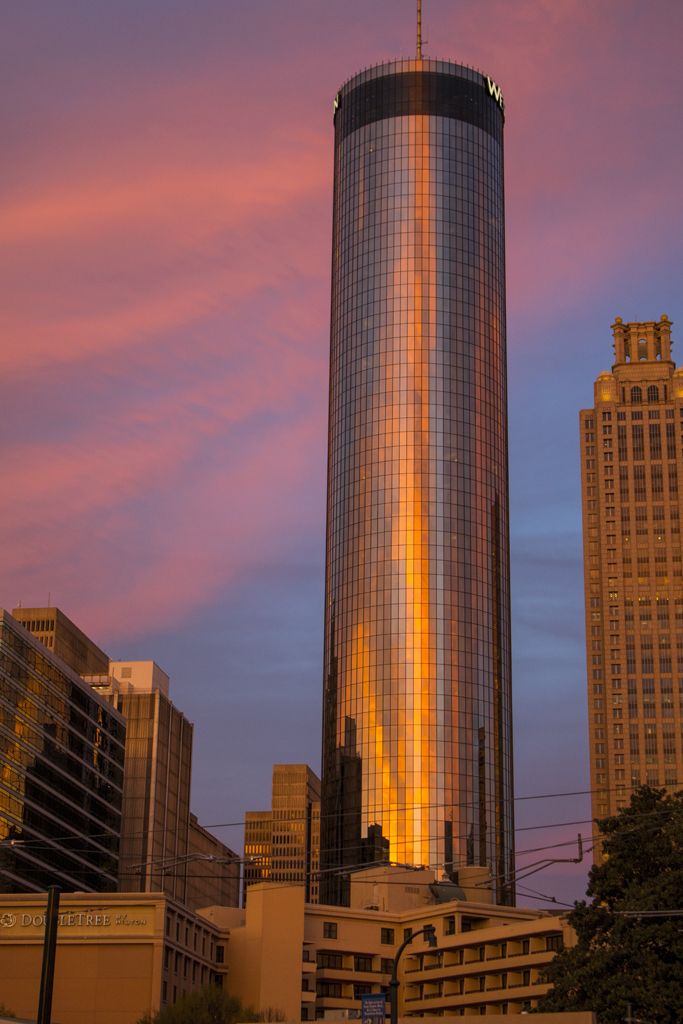
The first time I landed in Atlanta for my interview at CNN in 1981, I looked north from the terminal and saw that thing sticking up like a 12-year boy’s first real boner. The city Sherman burnt down was rising again and finally reaching puberty.
Thankfully, over the years, as Atlanta grew, so did its skyline and Portman’s glass pipette is less prominent.
Here in Detroit Henry Ford II, the Deuce, figured he’d more than double what Portman planted in Dixie and, together with Detroit leaders, commissioned the architect to duplicate Atlanta’s Peachtree Plaza, but then surround it with four octagonal office buildings all connected by a network of passageways that would challenge even the most accomplished spelunkers.
The new Renaissance Center, or RenCen, would become the symbol of Detroit…the Renaissance City. Planted on the banks of the Detroit River, facing Windsor, Canada, the RenCen overshadowed and loomed over older landmark downtown buildings such as the Penobscot and Guardian to herald the Motor City’s vitality and prominence, or at least assert it.
If anything, the RenCen was a photogenic feature that made for effective marketing materials.
Less than 20 years later it all went bad.
In 1989 I was transferred by CNN from Atlanta to Detroit to become its new bureau chief and correspondent. The company had me spend a few days getting to know the staff and the city before moving here. They put me up in what was then the Omni Hotel in the Millender Center…connected to the RenCen by a short pedestrian bridge over Jefferson Avenue.
Of course, I had heard of the RenCen and decided, one evening, to explore this famous landmark. As soon as I entered it from the pedway I felt like a piece of dust might feel as it’s sucked into the collection bag of a Hoover. It was dark and directionless, with scant chance of quick escape.
If I was a mouse seeking a piece of cheese I would starve before finding the morsel since there was no apparent logic to the labyrinth’s layout. I wasn’t dumb enough to attempt to explore the complex because it was just too, well, complex. So I returned, disappointed, to my hotel room.
Not long after I moved up to Detroit and was with my camera crew, I returned with them to the RenCen to shoot an interview with a prominent economist at Comerica Bank which had offices in one of the towers. We weaved in and out between the towers and concourses searching for the right tube to ascend to reach our destination. We were late. We apologized. The economist laughed as he said, “This place sucks. Everyone gets lost…the first dozen times they come here.”
Another time, years later, as I was heading to a meeting a very upset man came up to me. “You look like you know your way around. Please, I heard there’s an ATM here. Can you direct me?”
Deciding this person was an honest Joe who did not deserve to have his hopes and dreams crushed, I looked him in the eye and said, “Sir. Even if I told you, you’d never find it. There’s a bank right across the street. Just head for the daylight of the exit and never stop. I want you to see your family again.”
The man instantly did as he was told. He knew. The RenCen’s tubes would suck you up like bacteria in a test lab.
The place not only didn’t make sense, but it wasn’t making any money as tenants fled to locations where employees, customers and clients could reasonably expect to find their destinations without the utter frustration of being caught in a glass and concrete hamster cage.
Just as it was given up for dead, in 1996 GM bought the place at a bargain rate and moved its world headquarters there from an historic building a couple of miles north. The automaker saved the day. Instantly, thousands of people occupied offices, supported the stores and restaurants. The RenCen had a new life!
Not so fast. Shortly after GM made the move we had an interview booked with then GM CEO Jack Smith. Nice guy. The interview was for our annual auto show special and our producer wanted to use lots of lights.
We plugged ‘em in. Our lights, and all the lights on the floor, went out. Guess the building wasn’t quite ready for prime time…or any time that required extra voltage. It took a few minutes, but the electricians did their magic and we smartly reduced our lighting scheme.
Smith was cool about it. “I guess there’s still some work to be done,” he said with an embarrassed chuckle.
There was plenty of work still to be done.
GM poured millions upon millions to finally take some of the mystery of navigating the maze with a simple innovation called the circulation ring. No more weaving in and out. Take the ring like a big traffic roundabout and bail out when you reached the exit closest to your destination. The big berms that walled off the complex from the rest of the city were torn down and the soaring Wintergarden was built, offering a bright gathering venue and passageway to the Detroit River.
Then Covid hit. People started working from home. The RenCen returned to its ghostly, pre-GM silence. After the pandemic abated, Barra said workers needed to return three days a week, but by then many of them had already relocated to other GM facilities and others just never returned.
It became time to find a smaller place for the automaker to park.
So what to do with it when Mary and all her sheep settle in their new pasture?
Some say to knock it down. Others imagine apartments, condos, restaurants, some commercial space.
In another era, it might have served well as a garrison guarding Detroit against hostile canon fire from gunboats on the Detroit River. Ah..Fort Renaissance! Tower 400 forever! We have secured the circulation ring! Remember the Marriott! It’s enough to make one forget the Alamo, which is much, much smaller and has an expensive gift shop.
Only because I’m semi-retired and have the time, I think about the future of the Renaissance Center. To demolish it would just add tons of waste to the environment. To save it would just leave tons of waste above ground where at least squatters could literally lose themselves for awhile.
Maybe get Carvana to turn one of the towers into its most giant vehicle vending machine. Wouldn’t you love to see your late model Buick do a swan dive from the 39th floor? Good way to test its shocks.
Offer bungie and parachute jumping over the river. Just make sure you packed your passport in case the winds make you wind up in Windsor.
Fill one tower with infused water for all those enjoying Detroit’s magnificent River Walk. Lotsa taps all around the tower where walkers, joggers, cyclists could fill their Stanley cups, less than a mile from where the Detroit Red Wings won their Stanley Cups. Joe Louis Arena is long gone but the ground remains hallowed. Hey…it’s all marketing, go with it.
In reality, the RenCen will probably become the banal “mixed-use” property with a variety of residences, hotels, stores, restaurants and maybe once in a while, sponsored races around the circulation ring.
I can’t wait to see how Mary Barra and master developer Dan Gilbert will reimagine the RenCen, because love it or hate it, it would be a colossal shame if our city’s signature bundle of glass towers was allowed to go down the tubes.
A Striking Difference

I don’t get out much…to cover stories, that is. Being semi-retired, freelancing for Forbes.com, I knock out most of my stories from the comfort of my home office, conducting interviews over Zoom or Teams or whatever electronic method allows me to wear sweatpants below a more suitable shirt.
But when you’re a news guy, no matter how old, there’s something you never lose—the urge to actually be out where the action is.
I’ve been covering the UAW strike against GM, Ford and Stellantis pretty much the way I described above, but the other day I decided I had to put on actual pants, and shoes, and ran down to Ford’s giant assembly plant in Wayne, Mich. In suburban Detroit, about a 30 minute drive from my house.
I told my editor I was out for “pictures and perspective.” What I really wanted was, yes, pictures, but to speak face-to-face with striking workers, learn their stories, find out why walking off the job was worth any financial sacrifice and yes, to smell the fires in those barrels along the picket lines where picketers could find a little warmth. They all smell the same and I like it.

I spoke with a guy wearing a reflective vest and a huge smile. His name is Roger. Said he’s just three months from retirement and could have easily just ridden out his time, but he told me it was worth spending time on the line to try to win financial security for, as he called them “the young ones.”
Roger told me the aggressive tactics taken by UAW president Shawn Fain were unlike anything his predecessors had attempted and at first “he scared the hell out of me.” But now Roger can’t wait to see if it all pays off.
I spoke with a woman who didn’t want to give me her name. No problem. I told her whatever insight and information she could offer was more important than her name. “OK, cool,” she said, now more relaxed. “I don’t care if we don’t get everything Shawn’s demanding, but just something better than we have now. We gotta get something.”
You don’t get this stuff sitting in your basement in front of a computer and I’d be out there every day except I’m not a full-time reporter anymore, after a certain number of stories I don’t get paid and working for free’s not the kind of charity the IRS will let me deduct.
I do think how things have changed, mainly due to technology, social media and the economy.
In 1998, when I was CNN’s Detroit Bureau Chief and correspondent I covered the entire 54-day strike at two GM parts plants in Flint, Mich. Resulting the automakers shutting down completely, costing it $3 billion after taxes.
We were out there every single day. On the picket lines, at the union halls, on the phone. Facebook and social media weren’t yet invented. The UAW president couldn’t go live, neither side posted details of their demands, offers and counter-offers. You got what you got from digging, from sources, from gumshoe reporting.
Working at CNN meant also doing about a billion live shots. I stood at a corner in front of Flint Metal Stamping for hours and hours knocking out one live shot after another, for CNN, for Headline News, for CNN International, for CNN affiliates.
Makes it hard to get any reporting done. I’d have to tell the sound tech to kill my mic so I couldn’t be heard over the satellite feed. Then I’d quickly make a call or two in between live shots to try to dig up some new nugget of news I could report.
Frequently, other reporters on the scene would stop and listen to what I was saying to see if they were either missing anything or if I was fulla shit.
I remember two of my friendly competitors—one at the AP, the other at USA Today paying especially close attention as I was on the air. You must know print reporters are contemptuous of broadcast journalists, figuring we’re all about hair and make up and not about honest reporting.
When I got off the air, they walked up to me and actually said, “we were listening to you and everything you said was right.” Well, why wouldn’t it be? Since we were friends they took no umbrage when I shot back, “bet you wish you could say that about your stories.” All’s fair on a breaking story.
That strike went on so long it actually jeopardized a promise I had made to my the, 10-year old daughter. Remember, this was 1998. The Spice Girls were huge. I had scored free tickets to their show at the late, great Palace of Auburn Hills, about a 30-minute drive down I-75 from Flint.
CNN, bless ’em, understood the gravity of the situation and actually sent in a reporter to relive me while I dashed down the freeway, took my daughter to see Baby, Sporty, Posh, and Scary—Ginger had just left the group, sad. It was, to that moment, the best day of her short life. Then I ran back up to reclaim my spot staking out the endless contract talks.
When the merciful end of the two-month ordeal was about to come to an end, there were no social media posts, no Tweets, or whatever they’re called now, no Facebook Live webcasts.
The most plugged-in reporters got tips on their phones from their best sources, then, to make it more official, a guy came running out of the Holiday Inn where the talks were going on and yelled, “hey! Press conference in 30 minutes! Get inside and set up!” That’s all we needed. So analog! So fun.
There’s something about being outside, on the scene, building relationships, swapping tips on where to get the best sub sandwiches for lunch. The folks at the plants ALWAYS know the best lunch spots. It’s never a chain place.
The guy at the local deli named for the guy who owned it was freakin’ Picasso of subs. Best bread, best meat, best cheese, best bullshit to share when picking it up. Wasn’t always bullshit. The great sandwich guy was also a great listener and often picked up tips he’d exchange for tips.
You don’t get that stuff sitting at a laptop or scrolling emails and texts on your phone. Sure, it’s convenient and fast, but it’s not as fun, and I bet the chainstore sandwich you ordered from Doordash sucked compared to the Stradivarius of Subs wrapped in wax paper with a fat pickle tucked in by the guy at the deli by the plant.
Well, it was fun getting out for a morning, chatting with folks just hoping to get their share of the bounty and a better life. Made my life better too…before I descended back to the basement.
An Open Letter to the UAW and Detroit 3 Automakers

Dear Contract Combatants:
I’m writing to you to request you move the expiration date of your labor contracts because it conflicts with a date related to my domestic bliss and continued marital comity.
You see, my wife and I were married on September 15th, 1973 about 370 miles east of Detroit in our native state of New York.
We were but 21 at the time and not yet even experienced enough in our careers to call us “green” meaning we had no congizance whatsoever of your quadrennial exercise in contractual Hunger Games.
We led fine and happy lives through our early married life, always approaching celebration our anniversary with happy anticipation and thoughts of expensive gifts and meals.
But in 1989 that all changed. CNN transferred me up to the Motor City from Atlanta to take over as the bureau chief and correspondent at the network’s Detroit Bureau. We covered a wide region and variety of stories from suicide doctor Jack Kevorkian to hurricanes, crime, medicine, government…everything, including, of course, the auto industry. Indeed CNN founder Ted Turner created the Detroit Bureau to cover, as he accurately called it, “the biggest industry in the world.”
That meant covering the contract talks between you guys and of course the contracts always expired on either September 14th or 15th. Since you almost never reached a tentative agreement by the expiration date we beat reporters would get stuck awaiting the white smoke to appear languishing, sleeping, filing, doing thumbsucker live shots, killing time until something happened.
Yes, you automakers fed us well. Any reporter of a certain vintage will not forget GM providing an almost endless supply of Dove Bars.
Good eatin’ but it kept me away from home on our anniversary which caused a combination of disappointment, anger, tears and fat chance reliving honeymoon night.
On our 20th anniversary in 1993, CNN took pity on me and sent former Detroit Bureau chief, the late, great Bob Vito to spell me at Ford headquarters. Nice touch, but Vito didn’t show up until 11:30pm on the 15th from Los Angeles because, as he put it, “I hadn’t had a Lafayette Coney in years and I had a craving.”
Not only was he very late, but had terrible chile dog breath. I got home with about 3 minutes left on our “special” day.
Every contract since, whether I was working in TV, the Detroit News or flipped over to PR at Chrysler, we’d have to time-shift celebration of our anniversary to avoid being screwed by you guys not shaking hands on a deal on time.
This year is our 50th anniversary. I’m now semi-retired but working freelance. I have informed my clients that I’m out of the mix this time around on the 15th. No matter what happens…deal, no deal, strike, no strike, I’m a ghost.
Even though technology..and common sense, has elminated the need for reporters to sleep at the various automakers’ headquarters awaiting word that you’ve either reached a deal or are playing the game into overtime, I’ll be spending the 15th blissfully someplace else, celebrating the fact my wife and I haven’t drawn pistols at dawn after half a century together.
But then, dammit, the clock will tick, the calendar will turn and the 15th will turn into the 16th and if you guys don’t figure it out by then I’m out of excuses.
So help a reporter out. Move the date your contracts expire to, say, the spring. How ’bout April 15th, tax day? No one celebrates that. How hard would that be? Maybe I’ll even buy you all Dove Bars.
Thanks very much,
Ed Garsten
Jimmy and Rosalynn: An Up Close Encounter
Seems like a good time to post this as former President Jimmy Carter and former First Lady Rosalynn are in what their grandson described as their “final chapter.
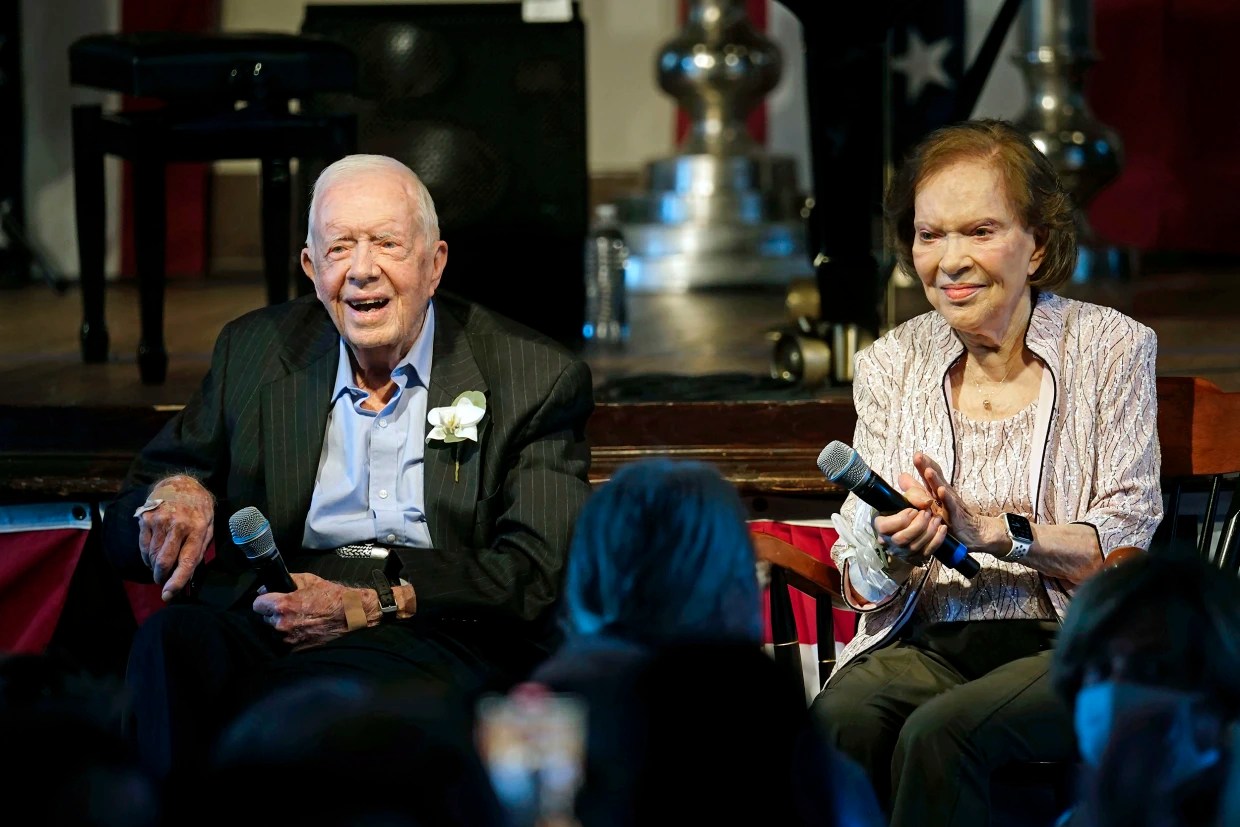
I was 24 when he was elected president. He came out of nowhere a one term governor of Georgia, former naval officer and deeply religious man. His improbable win for the White House over incumbent Gerald Ford was looked at as a move by the American people to clean house after the Watergate scandal. Carter was seen as an honest guy with a big smile and 180 degrees difference from the Nixon era. They lost his reelection bid to Ronald Reagan after failing to bring home the Americans being held hostage in Iran. Plus, I mean honestly Reagan could talk the antlers off an elk.
Well, after that, I never gave Carter another thought until 1986 when I was working as a correspondent for CNN based in Atlanta.
Georgia native Carter built his Presidential Library and Museum a mile or so from CNN headquarters, and I was assigned to cover its opening well ahead of the opening ceremony.
I was among the handful of reporters invited to tour the place our guides, none other than the former President and First Lady Rosalynn. They were fascinating to watch from a distance of really only about two feet. Very quiet, very humble, very, very sharp.
Just before kicking off the tour, the couple made eye contact with every reporter, silently judging us I guess, certainly snapping indelible mental photos of us so they would never forget who we were, should we come into contact again. Or if they didn’t like our stories. Then we were treated to Jimmy and Rosalynn’s interaction with each other.
Here’s a man who had been the most powerful person in the world is quietly and respectfully asking his wife, but next Roselyn right here should instruct him as she pointed to one of the many gifts bestowed upon them from various heads of state and don’t forget this one. Yes, dear, the former president replied with a mild look and chagrin for not thinking of it himself.
But when we came to what was called a campaign room with memorabilia from his successful first campaign, you can see his bright blue eyes shine. Rosalynn backed away and let Jimmy do the honors.
As he described all the cool stuff on the walls and shelves and showcases from a moment that must have seemed like the highlight of his life. Kind of reminded me of a guy in his mancave showing off his big TV, sports autographs and a chip and dip bowl on the shape of his favorite football team’s helmet.
At one point, the former President looked over to his trusted partner who gave the equivalent of the “wrap it up Jimmy sign, time to move on.” And he did.
Now, regardless of what anyone thought of his politics, it was fascinating to see these two very public and once powerful figures in a more intimate setting, joking with each other, trusting each other bantering with us reporters, as if we bumped into each other at the local coffee shop down in their hometown of Plains, Ga. and then they invited us over. Hey, why dontcha come over, take a little tour of our new house just moved into? Yeah, for sure.
An indelible memory of a wonderful day in my long career of a former president and first lady who served the world long after they left office. It was cool, all right. Even if they scared the crap out of you when they locked out to your eyes like those kids in the Village of the Damned, but it was just a way of saying, I see you, treat us well in your story–and if you touch anything, I remember who you are.
Well, I don’t know how many days Jimmy and Rosalynn Carter have left in his life, but I’ll always be thankful to the former First Couple for that one.
Graduating Seniors

I like discounts but I don’t like being discounted. That’s why I’m letting it be known here and now I’ve not only graduated, I’ve gravitated towards a new classification. Enough word play? Ha! Ask ChatGPT for that kind of linguistic gymnastics.
So yes, I’m at a certain age where I’m offered, and happily accept, so-called “senior discounts.” Might be a buck or two, but I’ll take it, because who wouldn’t accept even a minimal deal?
But here’s my deal, and I offer it to all of you who spent enough time on Mother Earth to be called a “senior.” It’s time to graduate to another, higher, more meaningful and inclusive grade level.
We used to call dumb guys who got left back in 12th grade as “super seniors.” Well, I believe if you’ve made it past the years of toiling for a paycheck, shelling out for child care, college, weddings, Bar Mitzvahs and are onto enjoying whatever years you’ve got left in the tank, you’re pretty freakin’ super, but not stagnated as a “senior.”
Oh no. Considering all our experiences, insights, challenges faced and met, wisdom and matchbook collections we’re beyond “senior moments.”
Despite whatever wounds we’ve suffered, setbacks faced, enemies battled, in-laws tolerated, we survive and thrive through the ongoing wars of life.
That’s why I will now be known not as a senior citizen but as a “LIFE VETERAN.” Battle-hardened but not hard-bitten, still fighting the good fight from the comfort of my laptop and patio.
Oh, we life veterans have plenty left to give. Always ready with an anecdote we’ve told a million times, advice based on our decades of having gone through the same shit as “lower classmen and women”–those are people who, until this writing, may have aspired to graduate as senior citizens.
I will also suggest a special branch of the VFW where that acronym stands for Veterans For Wisdom. A place we can gather, bullshit to each other over cold longnecks and trade, yes, bits of wisdom based on experiences from our earlier lives. Never too late to learn.
AARP, take notice. I know you’ll accept anyone 50 and over for membership. 50? Those are still kids. Life veterans still wear Dockers that are older than 50. Yes, we’re in our own graduate-level class and quite satisfied.
What’s the age level to be classified as a life veteran? There is none. You’ll know it when you qualify. You look down. You’re wearing slip-on Skechers. It’s the uniform. Life veterans—wear it proudly—you’ve earned the right not to bend…and a senior discount.
 edLINES