Tagged: cnn
Consulting Adults
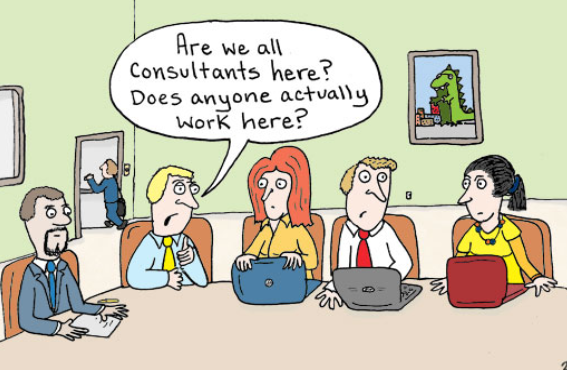
My first contact with a consultant came in 1979 at my first TV job. While attending grad school at the University of Arizona I landed a job as the weekend weather guy at the ABC affiliate in Tucson, KGUN.
I took to the job right away. After several years working as a morning drive time radio DJ, I was comfortable working without a script, ad libbing based on my map and information from the weather wire.
Our station was blessed with a great talent pool but crappy ratings, so they hired consultants based in Southfield, Michigan. The firm consisted of two former/failed news directors and an alleged “style” expert whose personal style was a cross between dust mop and tent maker.
I won’t waste a lot of words. They were crap. They had our main male anchor so self-conscious he actually wrote notes to himself onto the set: “Don’t over emote, don’t move your shoulders, don’t touch your pee-pee.” He added that last one in as a sign of rebellion.
They came after our elegant and talented main weathercaster imploring her to “act naturally.” When she protested that she WAS acting naturally, they told her to “act naturally another way.”
When it was my turn for consultant-certified scrutiny they seized on that fact that when only a little bit of rain was forecast, I would use the word “spritz.”
“Oh! That’s too eastern!” the consultants complained. I replied, “you mean too Jewish?” Busted. They looked at their shoes and moved onto my hair
Indeed, my viewers loved when I used that term and often joked with me when I was out in public, “hey Ed, is it gonna spritz today?” It was an everyday term back where I grew up in New York City, but a novelty in the desert southwest.
Turns out we dumped them because after two ratings periods under their “expert” guidance, our ratings actually fell even further.
What this whole prologue is leading to is I promised myself if I ever ended up as a consultant I could provide useful counsel based on my decades of experiences, while being sensitive to the company’s culture, goals and needs, not boilerplate nonsense.
So far, my two experiences consulting have mixed. In both cases I was told my experience would be valuable, helping staff improve their skills and opening the company’s eyes to new, or at least different angles for attacking certain issues.
After all, I built my reputation as a strong writing and producer covering thousands of stories as a reporter in radio, local TV, CNN, AP, Detroit News before jumping over to corporate PR.
During my 11 years at the various incarnations of Chrysler, I was known as a creative problem solver and innovator, pioneering the concept known as corporate journalism and introducing new methods and technologies, boosting the company’s exposure while saving it millions of dollars through efficiencies and bringing certain functions in-house.
Even before my last day on the job I was approached about lending my expertise to a news organization that was primarily print and online but contained a video element.
“You could teach us so much!” I was told.
Hmm. At first I was welcomed, but as time went on I detected several flaws in their TV production process and attempted to set them straight.
Oh! He’s gonna tell us we’ve been doing it wrong? Yeah. Change is hard. Doing it the same old way even if it’s wrong is easy. See ya, Ed!
The next one started more promising and lasted a few years until the company decided a consultant was really just a spare guy.
No…a consultant is not your spare writer, photographer, gofer, story pitcher. A consultant is there to advise and instruct your people already in those roles how to improve their performances or advise management on certain strategies.
What happens is people who are insecure, or perhaps in over their heads in their current roles, become very jealous and resentful of the outside consultant.
Honestly, consultants don’t want your job. We’re here just to help you do it better. If you can’t accept critique and instruction, perhaps you’re not mature or talented enough to remain in your position.
By no means are all consultants valuable or effective, as my experience back in Tucson attested.
If your company decides a consultant might be helpful, you need to really research the consultant’s track record of improvement, connect with current or former clients and then have that in-person conversation with the prospective advisor to see if it’s a good fit.
You also have to define the scope of work answering a few questions:
1-Why do you feel you need a consultant?
2-What skills and experiences does a consultant need to provide the counsel you seek?
3-How open is your corporate culture to accepting new ideas from outside the organization?
4-How will you prepare the staff for both scrutiny and direction from an outside source and why you feel it’s necessary?
Look, you don’t have to accept or adopt anything a consultant suggests, but by hiring one you’ve al least shown you’re open to examination, scrutiny and considering new ideas.
When it works, it’s a beautiful thing. When it doesn’t, admit it, don’t leave the consultant hanging. Be respectful, professional and courageous enough to end things decisively, informing the consultant why the engagement is ending.
Then you can both move on…without spritzing on each other’s parade.
Brief Encounters With Robert Duvall and Jesse Jackson
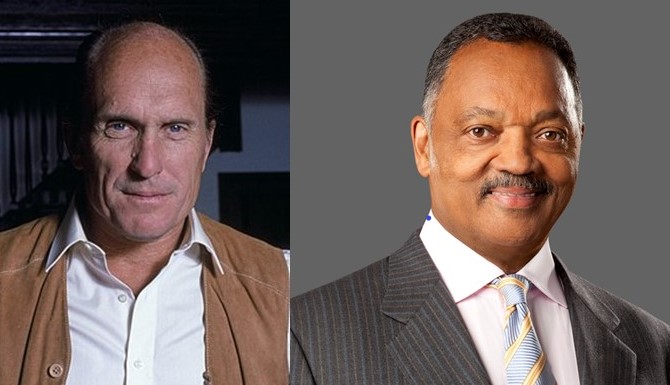
I won’t make either of these anecdotes bigger than they are. They’re just about little moments, brief encounters, with two notable gentlemen who left us this week.
I’ll start with one that involved no words between us. It was back in 1982 when I was a producer for what was then known as CNN2, later Headline News.
It was a slow Sunday and I was struggling to find enough stories to fill out my rundown for my back-to-back 30-minute newscasts.
The deadline to get the thing done and hand it over to the writers was looming and I was feeling the pressure.
We often had visitors come through the newsroom and I noticed one of them standing a little too close to me, trying to look over at my computer terminal to see what I was doing.
He was a short, balding man. Very quiet, but apparently curious as to what I was furiously working on.
Honestly, it was distracting to me and I didn’t need a stranger’s enquiring eyes boring in at that moment.
Finally, he moved on and as the supervising producer walked by I asked who was that little bald guy hovering in my space.
“Oh, just a guy taking a tour,” the supervisor said with a hint of sarcasm. “His name is Robert Duvall….he’s an actor.”
Yeah..just an actor. Robert, freakin’ Duvall..whose characters loved the smell of napalm in the morning and served the Godfather. Some little bald guy. Some incredible actor. Some clueless young producer who was so immersed in his own little task he missed the chance to have an actual word with one of the foremost actors of our time.
Except, for those brief moments, he seemed to be aware of me, and interested in what I was doing. I’ll take the win, and the memory.
The second little story involved the late Rev. Jesse Jackson. It was around 1987. By then I had been elevated to a correspondent at CNN out of its southeast bureau, based in Atlanta.
I had interviewed Jackson once before very briefly and I doubted he’d ever remember me. But he also hosted a program on CNN, so it was all in the family.
Long after that initial interview I was assigned to cover Jackson and a group he led presenting aid to drought-stricken farmers near Greenville, South Carolina.
As he and his contingent arrived, I started to approach him to grab a few words.
But before I could get too far, Rev. Jackson gave me a look and a subtle hand signal that telegraphed two messages: “not quite yet,” and “don’t worry, we’re CNN brothers,” but mostly, “back off.”
I quickly understood. Ever the media-savvy, and frankly, publicity-loving figure, Rev. Jackson and company staged an emotional photo op with the grateful farmers.
Once he was sure all the news crews got their shot, Jackson came over to me, smiled a little sheepishly and said, “thanks for getting the signal. Now, let’s talk.” And we did.
Yeah, sure, not giant stories, but little moments to recall related to a couple of disparate notables, and revel in how the privilege of being a journalist often presents the opportunity to encounter some very special people. May they both rest in peace.
44 Years Since CNN Took A Chance on Me
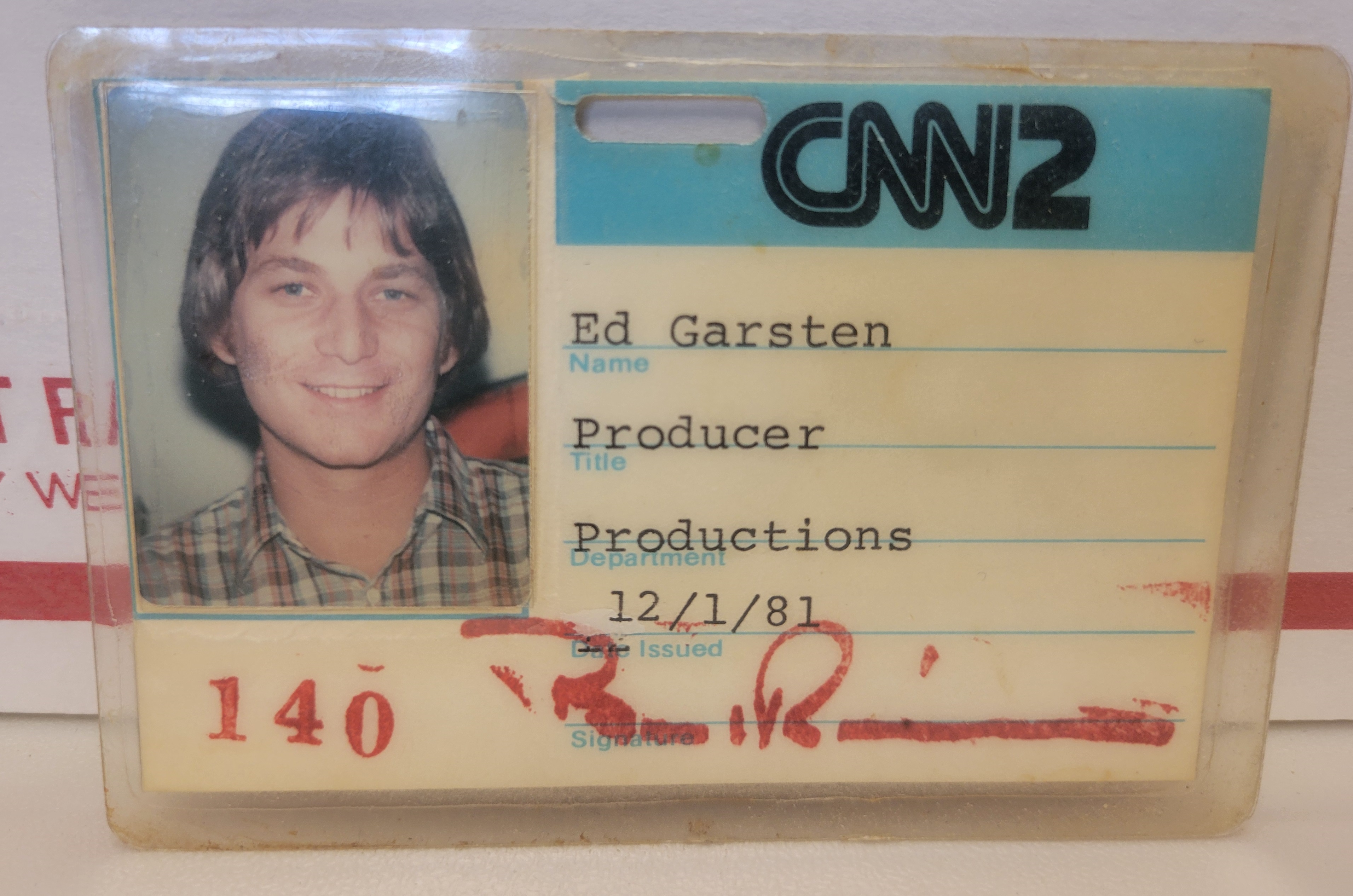
The ID badge is dated December 1, 1981 but November 30 was really my very first day at CNN, 44 long years ago.
It was a rainy day in Atlanta. I was alone in beautiful apartment with just a sleeping bag, air mattress, lawn chair, 19-inch TV and a cardboard box that served as table for eating, and some clothes. All my other stuff was in Tucson, Arizona, along with my wife, who flew back there to sell our little adobe block house. She was gone for three months, along with my stuff.
By the time our house was sold and my wife, and belongings and furniture arrived with her, that poor cardboard box was a greasy mess from its use as my dining room table/foot stool.
I was hired as one of the 10 original producers to launch the new network, CNN2, which eventually became Headline News.
If the bosses really knew how much experience I had producing television newscasts I’m sure they would have sent me on my way, but I fooled them with a kickass tape of my newscasts at KGUN, the ABC affiliate in Tucson.
You see, I joined the station doing weekend weather while I was a grad student at the University of Arizona, earning my Masters in Journalism. It was a way in. Within six months I was hired as a full-time reporter, which was my real goal.
That was going along fine when one day the news director called me in and said our longtime producer with 20 years experience had suddenly quit to take a job at a station in Phoenix and he’d love it if I took over.
Pretty funny. I’d never produced a TV newscast in my life.
“Oh, John will train you!”
He did. My first newscast after he left Ronald Reagan was shot. This was March, 1981.
CNN signed on June 1, 1980. I couldn’t watch it because our local cable system didn’t carry it, but I could catch little CNN news briefs on TBS, which was also part of the Turner Broadcast System.
One of the first anchors CNN hired was Lou Waters, who was the news director/anchor at our cross-town rival in Tucson, KOLD. He brought along his producer, Faye, who happened to be a great friend of our main weather caster Linda Rhodes, who formerly worked at KOLD.
That October, Linda tells me Faye tipped her off that CNN was starting a new network and needed producers. Was I interested? Uh, sure. Hell, I had a “solid” six months of experience. I was ready for the network!
I called the number Faye provided to Linda who gave it to me and next thing I know I’m on a flight to Atlanta on a Sunday. I was interviewed by every living body including the president of CNN at the time, Reese Schonfeld. We hit it off because I told him I worked at a radio station in Fulton, New York right out of college and damn, that’s where his wife was from!
I fly back to Tucson that evening with no expectations of landing the job, but the next morning, Burt Reinhardt, the top money man at the network, and successor to Schonfeld as CNN president calls me and offers me the job. Show up on November 30th.
I did, but it things got off to a clumsy start. Having worked in Arizona where no one gets dressed, I show up in a button down shirt, corduroy jeans and very comfortable shoes. Everyone else is in suits, ties, dresses and smirks, directed at me.
My boss, Ted Kavanau, a news legend from NYC, smiles, takes me aside and kindly mentioned, “as you can see we have a dress code.” Would have been nice to know in advance, but as I found out over the next 20 years, CNN was great at communicating news, just not important stuff to employees.
Ted told me to go over to the national assignment desk and ask one of the extremely busy people to explain how it worked.
I walk up to a bald guy with black-rimmed glasses and a beard and ask him the question. As he glares at my apparent insolence he barks, “you wanna know now the national desk works? Watch this!”
He then picks up the hotline to the DC bureau, starts screaming and swearing , then slams down the phone and quietly, but firmly, answers my original question with, “that’s how the fucking national desk works.”
When Ted asks me how it went I told him how my question was received. He kinda chuckled and said, “yeah, sounds about right.”
Welcome to network news.
I stayed at CNN2/Headline News for a little less than two years, producing hundreds of news casts in the most pressure-filled atmosphere you can imagine. Some producers actually broke down in tears under the pressure, others simply didn’t show up for work ever again.
In 1983 I was promoted to the main network to produce afternoon news casts, then promoted again to share producing the three hour morning show called Daybreak.
All this time, I would pick up a story here and there in hopes of moving back to reporting and by 1986 I was made a full time correspondent out of the Southeast Bureau based in Atlanta.
Here and there I would substitute anchor some newscasts and in 1989 the Detroit Bureau Chief/correspondent job opened. I tossed my tape into the ring and got the job. Been here in the Motor City ever since.
CNN dumped me and about 1,000 others during that “great” merger between parent company Time Warner and AOL in 2001, and closed the bureau.
We could have looked for work anywhere else in the country, but guess what, my family and I loved living in Michigan and I loved covering the auto industry.
Local TV wanted no part of me so I pursued print, because, let’s face it, I was never a TV star, but I could write. Best move I ever made.
It was funny, when I called someone at Ford for an interview while I freelanced for a short time at Automotive News.
“What? You write?” the guy at Ford asked. “TV guys can write?”
“Uh, yeah, I wrote every word that came out of my blow-dried head,” I replied.
“Heh,” he answered. “I thought producers wrote all that stuff for you guys.”
I had some great jobs in the print world. National Auto Writer at the AP, GM beat writer at The Detroit News, and in my semi-retirement, senior automotive contributor at Forbes.com.
But to come full circle, say what you want about what CNN has become, it opened a lot of doors for me when my time there ended there 25 years ago and still does.
The lesson I’d like to leave you all is don’t be afraid to step out of your comfort zone. Before I did the weather, I never did the weather, but I figured it out and succeeded. It led to dipping my feet into TV reporting. I sucked at first, but I received tough, but great direction from our photographers and news director.
I never produced a TV newscast but had a great teacher and got good enough to convince a network to hire me after only six months experience, and promoting me.
I never anchored a newscast when an executive at CNN saw something in me and gave me a chance. I solo anchored an hour network newscast with zero prior experience and it worked out, until the network president thought I looked a little too young. Tried to grow a beard, was too blonde..the lights washed it out.
When fate dealt me a blow I pivoted to print knowing I was a decent writer. Adjustments had to be made to transition from broadcast to print writing, but I was again lucky to have wonderful supervisors and editors to set me straight.
When I jumped to corporate PR at Chrysler, all the skills and news sense I had developed over the decades helped me succeed.
So if you’ve been laid off or otherwise “downsized,” just know you have skills that entirely transferrable and be willing to use them in different ways.
Take a chance, look beyond the obvious and usual. Not only will it help land a new gig, but it will open your life to new experiences and people and perspectives.
Most importantly, bet on yourself. The new stuff might seem challenging, scary, maybe even impossible, at first, but you know the chips in your stack.
Always, always, bet on yourself.
A Striking Difference

I don’t get out much…to cover stories, that is. Being semi-retired, freelancing for Forbes.com, I knock out most of my stories from the comfort of my home office, conducting interviews over Zoom or Teams or whatever electronic method allows me to wear sweatpants below a more suitable shirt.
But when you’re a news guy, no matter how old, there’s something you never lose—the urge to actually be out where the action is.
I’ve been covering the UAW strike against GM, Ford and Stellantis pretty much the way I described above, but the other day I decided I had to put on actual pants, and shoes, and ran down to Ford’s giant assembly plant in Wayne, Mich. In suburban Detroit, about a 30 minute drive from my house.
I told my editor I was out for “pictures and perspective.” What I really wanted was, yes, pictures, but to speak face-to-face with striking workers, learn their stories, find out why walking off the job was worth any financial sacrifice and yes, to smell the fires in those barrels along the picket lines where picketers could find a little warmth. They all smell the same and I like it.

I spoke with a guy wearing a reflective vest and a huge smile. His name is Roger. Said he’s just three months from retirement and could have easily just ridden out his time, but he told me it was worth spending time on the line to try to win financial security for, as he called them “the young ones.”
Roger told me the aggressive tactics taken by UAW president Shawn Fain were unlike anything his predecessors had attempted and at first “he scared the hell out of me.” But now Roger can’t wait to see if it all pays off.
I spoke with a woman who didn’t want to give me her name. No problem. I told her whatever insight and information she could offer was more important than her name. “OK, cool,” she said, now more relaxed. “I don’t care if we don’t get everything Shawn’s demanding, but just something better than we have now. We gotta get something.”
You don’t get this stuff sitting in your basement in front of a computer and I’d be out there every day except I’m not a full-time reporter anymore, after a certain number of stories I don’t get paid and working for free’s not the kind of charity the IRS will let me deduct.
I do think how things have changed, mainly due to technology, social media and the economy.
In 1998, when I was CNN’s Detroit Bureau Chief and correspondent I covered the entire 54-day strike at two GM parts plants in Flint, Mich. Resulting the automakers shutting down completely, costing it $3 billion after taxes.
We were out there every single day. On the picket lines, at the union halls, on the phone. Facebook and social media weren’t yet invented. The UAW president couldn’t go live, neither side posted details of their demands, offers and counter-offers. You got what you got from digging, from sources, from gumshoe reporting.
Working at CNN meant also doing about a billion live shots. I stood at a corner in front of Flint Metal Stamping for hours and hours knocking out one live shot after another, for CNN, for Headline News, for CNN International, for CNN affiliates.
Makes it hard to get any reporting done. I’d have to tell the sound tech to kill my mic so I couldn’t be heard over the satellite feed. Then I’d quickly make a call or two in between live shots to try to dig up some new nugget of news I could report.
Frequently, other reporters on the scene would stop and listen to what I was saying to see if they were either missing anything or if I was fulla shit.
I remember two of my friendly competitors—one at the AP, the other at USA Today paying especially close attention as I was on the air. You must know print reporters are contemptuous of broadcast journalists, figuring we’re all about hair and make up and not about honest reporting.
When I got off the air, they walked up to me and actually said, “we were listening to you and everything you said was right.” Well, why wouldn’t it be? Since we were friends they took no umbrage when I shot back, “bet you wish you could say that about your stories.” All’s fair on a breaking story.
That strike went on so long it actually jeopardized a promise I had made to my the, 10-year old daughter. Remember, this was 1998. The Spice Girls were huge. I had scored free tickets to their show at the late, great Palace of Auburn Hills, about a 30-minute drive down I-75 from Flint.
CNN, bless ’em, understood the gravity of the situation and actually sent in a reporter to relive me while I dashed down the freeway, took my daughter to see Baby, Sporty, Posh, and Scary—Ginger had just left the group, sad. It was, to that moment, the best day of her short life. Then I ran back up to reclaim my spot staking out the endless contract talks.
When the merciful end of the two-month ordeal was about to come to an end, there were no social media posts, no Tweets, or whatever they’re called now, no Facebook Live webcasts.
The most plugged-in reporters got tips on their phones from their best sources, then, to make it more official, a guy came running out of the Holiday Inn where the talks were going on and yelled, “hey! Press conference in 30 minutes! Get inside and set up!” That’s all we needed. So analog! So fun.
There’s something about being outside, on the scene, building relationships, swapping tips on where to get the best sub sandwiches for lunch. The folks at the plants ALWAYS know the best lunch spots. It’s never a chain place.
The guy at the local deli named for the guy who owned it was freakin’ Picasso of subs. Best bread, best meat, best cheese, best bullshit to share when picking it up. Wasn’t always bullshit. The great sandwich guy was also a great listener and often picked up tips he’d exchange for tips.
You don’t get that stuff sitting at a laptop or scrolling emails and texts on your phone. Sure, it’s convenient and fast, but it’s not as fun, and I bet the chainstore sandwich you ordered from Doordash sucked compared to the Stradivarius of Subs wrapped in wax paper with a fat pickle tucked in by the guy at the deli by the plant.
Well, it was fun getting out for a morning, chatting with folks just hoping to get their share of the bounty and a better life. Made my life better too…before I descended back to the basement.
Secrets of CNN Center From Its First Supervising Producer

Two Eds are better than one. Ed Turner and me at the Supervising Producer pod in CNN Center
The news broke this week that CNN Center in Atlanta will be closing by the end of the year. Here’s something few people know. I was the first supervising producer on duty when CNN Center opened in 1987.
I was working the 11pm-7am shift in preparation for the morning show called Daybreak at the time. Sounds like a shitty graveyard shift, but overnight in the States is prime time for overseas news. Can’t say “foreign” news because Ted Turner didn’t allow it. You had to say “international” or some other synonym for news not happening in the U.S. because, he correctly asserted, people in Bulgaria hearing news about their country wouldn’t consider that news foreign. Ted was a pretty brilliant guy.
We weren’t actually on the air yet from CNN Center. That would happen when Daybreak signed on at 6am. The last live newscast from CNN’s original location at 1050 Techwood Drive across from Georgia Tech University was Newsnight Update, which ended at 1:30 am.
With a TBS camera rolling for an upcoming documentary on the move at the appointed time I called over to Techwood to say something like, “operations are complete at Techwood. Time to move the mile or so down to CNN Center.” I’m sure it was better than that but sadly I never documented my remarks because I was sure they were unremarkable.
A little while later, Susan Rook, who had anchored that last live show from Techwood, arrived at CNN Center with a gift for me. She had removed one of the CNN logos on the anchor set and presented it to me. It’s on my office wall along with a photo from the 1989 CNN bureau chief’s meeting in Ted’s office and a poster signed by Ted wishing the Detroit Bureau luck when it opened in 1982.

I was the Detroit Bureau chief and correspondent from May, 1989 to January, 2001. When I was laid off in the great purge of ’01 I took the framed poster with me. The bureau was closed later that year.
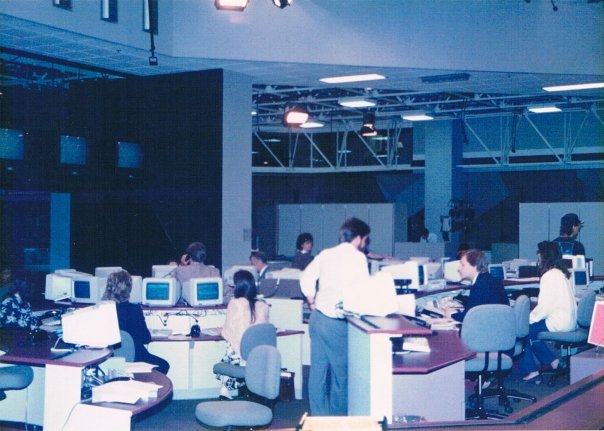
Something else about CNN to which I will sheepishly admit. While the place was under construction I was appointed to a committee to help design the layout of the newsroom. For some reason I had the hairbrained idea it would be cool to emulate a print newsroom set up with circular team workstations with an editor in the middle—the slot..get it?
To my dismay the others loved it and that’s the way the “pods” were built. They were almost universally despised. Writers and producers around the rims were uncomfortable and the editors often complained of feeling like chestnuts roasting on ambient fires.
Once I caught wind of this dissatisfaction I never once, until this moment, mentioned that I was largely responsible for my colleagues’ misery. Apparently no one else remembered and the subject was never brought up. Why am I admitting this now? Because someone is likely to write another “history” of CNN and not get it exactly right. Call me.
For many years I had the blueprints for the newsroom design and I still might, but I can’t lay my fingers on them because there’s a good chance one of my family members used it to wrap Christmas presents and they’ve long ago been buried in a Michigan landfill. I have some boxes to exhume. Maybe they’re in there. But I won’t be looking today.
One of my strongest recollections from being the first supervising producer at CNN Center was learning the layout, especially the location of the washrooms. You see, working at CNN could be very stressful and when someone had the need there could be no delay.
It actually cracked me up as I sat in the elevated supervising producers pod, which was crescent shaped and not round, and crazed producers and writers who hadn’t taken advantage of the advance tours, screamed at me, “where the hell is the fuckin’ bathrooooooom!” If it was someone who had exhibited especially ass-holey behavior to me in the past, I’d kinda look up and ask, “what?” “Gotta go!!!!! Where!!!!!????” they’d holler while nature was hollering back at them. Then I’d point them in the right direction.
Often, when there were finished doing their business and returned to the newsroom they’d offer their appreciation for the information I shared with a familiar hand gesture, which I’m sure, in some culture, meant, “Next time I will pee on your shoes.”
Being the supervising producer meant largely, um, nothing. You didn’t actually produce. You mainly made sure the upcoming newscasts were leading with the best and latest stories, the producers knew of new material coming in on the satellites and if someone called in sick you had to find a replacement.
I loved that part. A producer would call in sick at, say, 1am and I’d ring up the designated replacement. Without fail I had rousted that person from their chaotic dreams and they’d bark at me, “do you know it’s the middle of the freakin’ night?” I’d calmly reply, “it’s the middle of my work day. Need you to come in tomorrow and produce the 2pm show.” Rough words were exchanged but the deed was done. I’d won again.
Working in the middle of the night I often had conversations with correspondents stationed overseas. Sometimes it was to approve a script, but at least one based in Japan just wanted to talk because he was lonely.
During many of the hours when I had literally nothing to do, I’d decide to prowl the oddball nooks and crannies of CNN Center. From the top floor of the CNN space you could look out at the atrium and see all sorts of things. Sometimes I’d see couples emerging from the movie theater or Omni Hotel or offices that were coupled with other people in real life. Omerta!
I remember the very last time I was in CNN Center. I had come down from Detroit in late 2000 to meet with the bosses. It was a one-day quickie. Unremarkable, but somehow I knew my time at the network would end soon. I kinda turned around and took what I just felt was my last look at the place and cracked up to myself thinking, “those poor slobs are still sweating in my pods.”
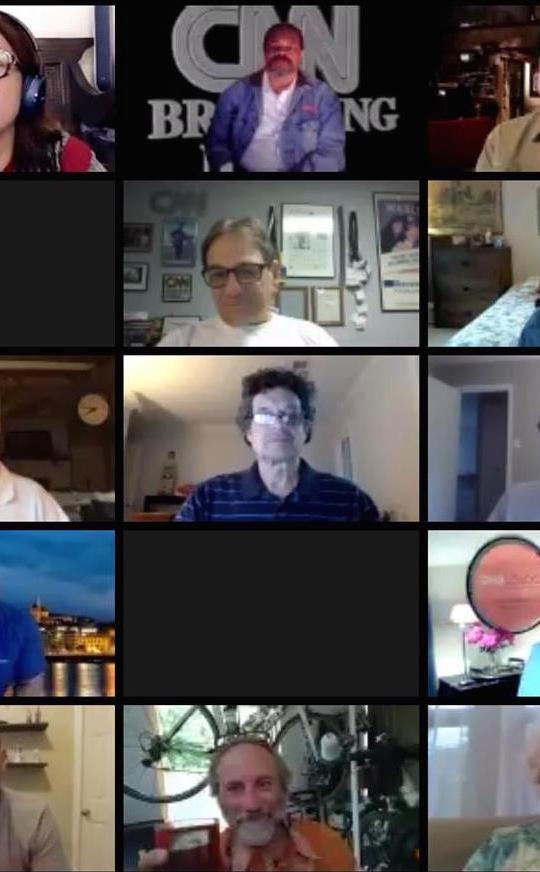
A 40th CNN Reunion…in Boxes
I spent last night in a little box. I was in one of a thousand little boxes filled with faces of people with whom I once worked or who had worked in the same place as me at some point. It was billed as the CNN 40th Anniversary Virtual Reunion. Five years ago for the network’s 35th, we gathered in person and snacked on premium hors d’oeuvres in an Atlanta hotel ballroom while getting an up close look at how everyone’s aged, been preserved, thickened, thinned, dyed, dried, shrunk, grew, lost a step or lost their hair.

On this night, through the miracle of Zoom and a Herculean effort by selfless CNN alumni who wouldn’t let a silly little pandemic spoil the party, we celebrated the network’s fourth decade.
In the “gallery view” on Zoom it appeared as if this was the Brady Bunch open gone mad. I swiped through pages and pages of these little boxes trying to pick out familiar names with faces, in some cases, no longer familiar looking, but I was relieved to see my fellow relics still alive.
I honestly don’t have much of a taste for reunions. I’ve never attended any for my high school or colleges, but I make an exception for CNN. You can say what you want about the network’s current programming, but as our former CNN president Tom Johnson implored us in one of the breakout chat room last night, “don’t bash the network in public.” But why would I? My 20 years there made everything possible after my employ there ended in 2001. The standards we held concerning accuracy, ethics, teamwork and unselfishness define who I am today. I’ve brought all those tenets to each of my subsequent jobs and to my life.

We always say CNN is a family. Dysfunctional at times, chaotic at others, but always supportive, even after we’ve moved on. That’s because we know what we created. Before the media landscape changed with the advent of the internet, social media and the move by news networks to largely opinion and bullshit machines, we were all about telling stories…not just talking about them. I took great pride in my writing…still do. I wasn’t ever much of a TV personality and that was fine. But sending crews out to shoot, report and feed stories is expensive. Talking heads on a set to blab about stories is cheap and today cheap is good. The cost is the future of journalism–fairly and responsibly informing the public skillfully and effectively.
So it was fun to see old friends, even in little boxes, reminisce and trade some old war stories. For me, it wasn’t so much, though, to remember and embrace the “good old days,” but for us also trade the knowledge gained through our years at CNN and beyond, at some point you celebrate what we’ve accomplished together, knowing all that thinking outside the box brought us together inside them on this glorious night.

Those Uncomfortable First Days

While we’re all waiting for the world to spin back on its axis and people aren’t getting sick or afraid of breathing in public, I thought it might be fun to kill some time thinking back to one of life’s most uncomfortable episodes–that horrible first day on the job.
You know how it is…you don’t know where anything is, everyone in the office is giving you the eye wondering if you’re OK or a jerk or if you’re gonna try to steal their job or be an ass-kisser or slacker. Your main challenge is delicately asking where the washroom is and where the office supplies are hidden. Some wiseass gives you directions to the washroom, but after you memorize every turn and finally find the door as you’re about to explode, you discover the schmuck didn’t add that you need a key to enter. Sound familiar?
I’ll start with a couple of my most memorable/horrible first days, and then I invite you to join the fun by adding yours in the comments.
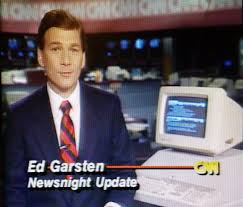 The date was November 30, 1981. My first day at CNN in Atlanta. I was hired as one of the first producers to launch their second network which was known at the time as CNN2. It later morphed into Headlines News and now HLN.
I had been working as a producer, reporter, anchor at KGUN in Tucson, Arizona. If you know anything about Arizona, it’s extremely laid back. No one gets dressed up, much. Especially producers.
Well…I saunter into the crazy, busy CNN headquarters on my first day figuring I’d wear my “producer clothes.” In Arizona that meant casual pants, an open-necked button down shirt and comfortable shoes. Psych. I look around and everyone else is wearing serious business clothes. Women wearing dresses. Men in dress shirt, ties, jackets, polished, black shoes. I’m already marked as a rube from out west. My boss kindly takes me aside and whispers, “you may have noticed there’s a bit of a dress code.” Well..yeah…would have been nice if someone told me in advance. But that wasn’t the worst thing about my first day. That would happen momentarily.
The boss said we should go out onto the newsroom floor and learn how the national assignment desk worked. So I go up to the first guy I see on the desk. He’s a big, balding, bearded volcano about to erupt. I introduce myself and ask if he could take a moment to explain how things work. Cue the eruption.
“YOU WANNA KNOW HOW THE FUCKIN’ DESK WORKS! WATCH THIS!!!!,” he screams at me. He picks up the tie-line to the DC bureau and starts screaming at the producer on the other end using the most vile language one could muster. This goes on for about 20 seconds. He slams down the phone, glares at me and screams, “THAT’S HOW THE FUCKIN’ ASSIGNMENT DESK WORKS. NOW GET THE FUCK OUTTA MY FACE!!!!” I took that as a most instructional lesson, took my leave and, you know, I never got the guy’s name or saw him again, which was just fine. Boss later asks me if I got the lay of the land on the national desk. I told him about the “guidance” I was given and just grinned, replying “yeah, that’s pretty much how it works.”
 First day number 2. August 23, 2005. My first day at what was then DaimlerChrysler and now Fiat Chrysler Automobiles. It was my first corporate job. Hired away from The Detroit News to ghost write and manage a blog for the head of corporate communications. Cool job.
I’m led up to the sixth floor PR offices at corporate HQ and plopped in my new boss’s cube for all the first day stuff. First thing I was told was to look at my new badge.
“See your badge? It’s green. That means you’re a contractor not a REAL employee. REAL employees have blue badges.” I feel welcome already. Then the next indignity.
“Come with me. Let’s look out the window. You see those parking decks close to the building. You can’t park there. Those are for REAL employees. See that surface lot..somewhere beyond the horizon? That’s where contractors park. So that’s where YOU park. It’s not too long a walk…except when it’s raining, snowing or the wind is howling. Then…it sucks. Welcome to the company!!”
I became a REAL employee about 13 months later but always hid my blue badge. It was out of consideration for the other green badged contractors who were still trudging into the office from the corporate back forty. They would also call me bad names.
Parked in the Motor City

The reaction from my mother made no mistake about her feelings. “Who did this to you!?!” she shouted over the phone.
I calmly replied no one “did this” to me. I asked for the transfer from Atlanta up to Detroit. It would be a big promotion. She still wasn’t happy since my parents had only retired to Florida from NYC the year before, putting them a lot closer to us and to two of their grandchildren.
It was 1989. I had worked at CNN since November, 1981 in Atlanta, first as a producer on the launch team for what was then called CNN2 and is now a far different network called HLN. Over the next 7 years I moved over to CNN as a producer, supervising producer, correspondent and fill-in anchor but what I really wanted to do is run a bureau. In the spring of ’89 that opportunity opened up when the incumbent Detroit Bureau Chief-Correspondent won his long-sought transfer to the bureau in Rome.
Not many people wanted to move to Detroit. They feared being murdered immediately upon arrival or finding their cars, wheel-less perched on milk boxes. Not me. I grew up in NYC. I loved cities, their energy, cultural mix, history and odds of covering some important and exciting stories.
So I applied…and got the job. It didn’t disappoint me. As a regional bureau we covered all of Michigan, Ohio, eastern Canada and wherever else the national assignment desk sent us. The Detroit Bureau staff was welcoming and we worked together very well.
This month marks 30 years since we hauled our kids and our stuff up I-75..and parked in Detroit.
My introduction to some of the players in Detroit, however, was, well, not quite as smooth as my start at the bureau. I was asked to give a talk introducing myself to the public relations community at a luncheon. If you know me, you know I’m a pretty short guy. Well..the fellow who introduced me was even shorter! Me, being the wiseass I am, came up to the mic, next to the unfortunate guy, looked down at him and cracked, “I think I’m gonna like it in Detroit!” The audience got the joke and laughed. My fellow shrimp did not, and promptly sulked in his seat. OK…note to self: “Detroiters are height-sensitive.”
It wasn’t long before the late, great J.P. McCarthy invited me onto his morning show on WJR. He promptly took me to task for what he felt was the national media’s obsession with beating up on Detroit I explained CNN had no such obsession, but you couldn’t simply ignore what was really happening. But things took a more positive turn when he asked me to tell an anecdote about Ted Turner, since there were a lot of bigwig corporate executives in his audience. I told him about Ted showing up in the Atlanta newsroom in his blue terrycloth robe on a Saturday morning and cajoling with the staff. We all loved him. J.P. liked that story and over the years invited me back a few times and I was very honored to be a guest during his last week of programs before he retired. Each time, he wanted another Ted Turner story. I always came prepared.
I also love Detroit because the folks are not only welcoming, but blunt in just the right way. My first week in Detroit I was assigned to an auto sales story and was scheduled to interview the head numbers cruncher at Ford. He was weeks way from retirement and feeling a little feisty.
“You know anything?” he barked at me.
“I’m new on the beat so I’m open to learning,” I humbly replied.
“Well, listen to what I say, report it accurately, don’t write any bullshit and we’ll get along fine. So ask me some questions and they better be good ” he, um, advised.
“Yessir.”
A year or two later I ran into the gentleman at a press event and he smiled as he came over to me and said, “I gave you serious shit when you were new but you more than proved yourself.”
“Thank you very much, sir.”
Detroit. Awesome.
We always thought Detroit was just another stop on the road. My wife and I met at college in Oswego, N.Y., got married a few months after graduating and had lived in Central New York State while I started my broadcasting career at a couple of radio stations, then we took off for Tucson, Arizona to earn our Masters degrees and where I got my first TV job at KGUN, first as weekend weather guy, then reporter, then producer, until I got the tip about the job at CNN.
We loved Atlanta and were actually looking for a larger house as our family grew, but then Detroit happened. Sure..three-year contract for the new position, then who knows?
But CNN renewed me a few more times until they closed the bureau in 2001 and I was laid off along with about a thousand other people. What to do?
Well, there was zero talk about leaving Detroit. We actually lived in the suburbs but we loved the area, Michigan and the people. We became avid fans of all the sports teams, attended games and took advantage of all the area had to offer.
Luckily I had a pretty good reputation in town and I quickly won the National Auto Writer position at the Associated Press, then was recruited by The Detroit News to be the General Motors beat writer and jumped to corporate when the head of PR at DaimlerChrysler started a blog and wanted an autowriter to ghost write and manage for him. Sweet job! That job morphed in an 11 year stay at the automaker where I was the first head of digital communications pioneering the concept of “corporate journalism” with my wonderful, creative team.
In 2016 I decided to retire, but leave Detroit? Leave Michigan? What the hell for? All the things our family enjoys are right here…so we sold the home we had lived in since 1992 and moved exactly 2.5 miles away to another house that had a lot of the features missing in the old one. I’ve been blessed with just enough freelance opportunities to keep me sufficiently out of my wife’s hair and around enough to be of use when called upon.
The bottom line is America has Detroit all wrong. It may be the country’s best kept secret. Great people, culture, major league sports, awesome restaurants, any kind of recreation nearby..even fowling. Look it up. For us, it’s been home for 30 years and we hope to remain here until the grim reaper comes calling….or the Detroit Lions win a Super Bowl. Hmm. Here to stay.
Requiem for a hilarious genius
There aren’t many scenarios where one would not only enjoy working the graveyard shift but actually look forward to dragging in their sleep-deprived butts at an hour when most people are tucking their sleepy selves into bed for some proper slumber.
But for two, brief, fleeting, wonderful years, I was blessed with this paradox. The only reason it was so, was because of a hilarious genius named Peter Vesey.
At the time I was co-producing CNN’s morning show called “Daybreak.” The newcast aired from 6 a.m. to 9 a.m. which meant we reported to work at the cruel hour of 1 a.m. to prepare it. When our executive producer moved on, Peter replaced her. His reputation as a brilliant broadcast journalist preceded his arrival and the team was excited for the chance to work with Peter and learn from him. We never anticipated he would also make working while others were sleeping so much fun.
Our pre-show meetings instantly transformed from robotically listing available stories, reporter packages and expected satellite feeds to uproarious discussions filled with Peter’s humor, logic and spot-on guidance while he constantly challenged us to try new production methods, accelerating the show’s pace, sharpening our writing and above all, creating a newscast that engaged and informed our viewers that hooked them to the screen.
We had fun critiquing the material, to the extent of Peter’s ability to create verbal caricatures of several correspondents. One, in particular, made every piece sound like an industrial film, intoning like a mechanical voice. We were sometimes a little cruel in our critiques but all in good fun while honestly assessing their strength and worthiness to make air.
In the control room, he ruled calmly and decisively while tossing in crackling bon mots to keep the crew loose and engaged.
Peter took a personal interest in all of us, always inquiring about our lives, families, health and career goals. He also didn’t take any shit. Anchors with an attitude were quickly shut down. Officiousness was dealt with an immediate smackdown. My favorite example:
The supervising producer sat across from Peter. There was perhaps one-foot between them. This was the 80’s so there was an attractive Trimline wall phone at each work station. One-inch separated Peter and the supervisor’s wall phone. Peter’s phone rang and when he picked it up, the voice on the other end of the line was the supervisor… only inches away. Instead of saying “hello,” Peter reached over to the supervisor’s phone, yanked it off the wall and tossed in in the trash and said, “what was it you wanted?” I’ve never stopped laughing about this in 30 years.
There weren’t many food options in the middle of the night and I’m a crappy eater anyway, so I gravitated towards the emaciated Polish sausages available at the small cafeteria located in the odd atrium that separated CNN from CNN Headline News. Of course, Peter silently took note of my foolish food choice and parked it away for future use. That came to pass when I moved on from Daybreak to a reporting position. Near the end of our shift Peter announced the team had a little going away gift for me. He brought out a rectangular cake pan covered in foil. Oh…a going away cake..how cool. Oh sure, there was a nice cake with vanilla frosting…and a big, fat raw Polish sausage sticking out of the middle. It brought tears to my eyes.
But now my eyes are tear filled again and my heart broken with the news Peter passed away after a short illness.
I hadn’t spoken to Peter in many, many years and a couple of months ago the director on our show passed along his number to me and said Peter would welcome a call. I didn’t make it. Believe it or not, I simply felt shy about it. Peter would have set me straight…and asked if I was still eating those stupid sausages. I would have welcomed that.
The hurricane battle to beat Dan Rather
Being based in Detroit for CNN I didn’t have much of an opportunity to cover many hurricanes, but when Hurricane Andrew was done with Florida and crossed into the Gulf of Mexico, my crew and I were assigned to intercept it.
We had been covering a big flower show in Columbus, Ohio when the call came. After apologizing to our PR handlers, they nicely provided us with big golf umbrellas emblazoned with the flower show logo in its purple and white color scheme, which we stashed deep into our Anvil cases. We promised to come back and finish the story when we returned from our hurricane coverage.
After rushing back to Detroit to load up additional gear, we flew to Houston and made our way to Galveston, awaiting Andrew’s arrival. By the next morning we learned the hurricane was tracking further east and told to keep driving till “you and Andrew meet.” In Lake Charles, La, we picked up field producer Kelly Rickenbacker who had covered more than 20 hurricanes for CBS, so we were in good hands. Kelly turned out to be the difference between winning and losing a deathmatch competition with none other than Dan Rather.
Heading east on I-10, we could feel ourselves getting closer to the storm. In Lafayette, we got out to shoot some video and were forced to take cover under our Ford Econoline van when a metal building was blown apart by winds, sending its razor-sharp section of aluminum through the air. Some cut right through trees. We were avoiding them slicing through our bones.
Further on, our national assignment desk in Atlanta instructed us to reach a town called Abbeville where a satellite truck was parked. “Just get out, get in front of the camera, and be ready to tell when you’ve seen for the last hundred miles or so.” Having done that we were back in the van when Kelly learned of major destruction in the town of Jeanerette. He also learned Dan Rather and a crew from the program “48 Hours” was aiming for that town too. The issue? Police had cut off access roads to the Jeanerette but it was clear we needed to get in and tell the story, with the added incentive to get there before Rather and Co. and get our story on the air.
Upon reaching the first roadblock, Kelly suddenly affected an accent that was a little bit of honey, a smidgen of sweetened ice tea, bolstered by the taste of a perfectly fried biscuit. That seemed to be the dialect that spoke to the heart of sheriff’s deputies who were otherwise unimpressed with our plight. They smiled at Kelly, shook his hand, and moved aside the sawhorses blocking the road to Jeanerette. Kelly kept up his act at least two more times and we suddenly found ourselves in the Jeanerette city limits where the affects of Andrew were all too obvious.
We grabbed some shots on our way into town, stopped at a shelter, all the while asking lots of pertinent questions, along with “you see Dan Rather here?” None had. We blasted away shooting as much as we could in the short time we had before hightailing it to Morgan City where the CNN satellite truck was parked, from which we’d feed in our story for the 6 p.m. show.
Knowing there would be no time to look at our video, I kept an informal log of what our videographer Chester Belecki had shot in Jeanerette and while tucked in the back seat of a very crowded minivan..Kelly had taken the big van separately..I scratched out a script and recorded the track into the camera.
Boom..we edited the piece in the satellite truck and fed it in time to make our deadline…beating Dan Rather by at least two hours..and most everyone else. Victory in hand, the desk instructed us to go on to New Orleans, get some sleep, and go home.
Postscript. The poor flower show umbrellas died a quick death after five minutes in the hurricane winds. We did go back to finish the story…about why the much-publicized show was a financial failure.
 edLINES