Tagged: leadership
Consulting Adults
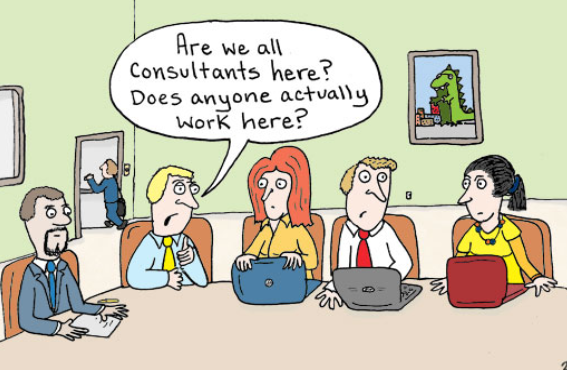
My first contact with a consultant came in 1979 at my first TV job. While attending grad school at the University of Arizona I landed a job as the weekend weather guy at the ABC affiliate in Tucson, KGUN.
I took to the job right away. After several years working as a morning drive time radio DJ, I was comfortable working without a script, ad libbing based on my map and information from the weather wire.
Our station was blessed with a great talent pool but crappy ratings, so they hired consultants based in Southfield, Michigan. The firm consisted of two former/failed news directors and an alleged “style” expert whose personal style was a cross between dust mop and tent maker.
I won’t waste a lot of words. They were crap. They had our main male anchor so self-conscious he actually wrote notes to himself onto the set: “Don’t over emote, don’t move your shoulders, don’t touch your pee-pee.” He added that last one in as a sign of rebellion.
They came after our elegant and talented main weathercaster imploring her to “act naturally.” When she protested that she WAS acting naturally, they told her to “act naturally another way.”
When it was my turn for consultant-certified scrutiny they seized on that fact that when only a little bit of rain was forecast, I would use the word “spritz.”
“Oh! That’s too eastern!” the consultants complained. I replied, “you mean too Jewish?” Busted. They looked at their shoes and moved onto my hair
Indeed, my viewers loved when I used that term and often joked with me when I was out in public, “hey Ed, is it gonna spritz today?” It was an everyday term back where I grew up in New York City, but a novelty in the desert southwest.
Turns out we dumped them because after two ratings periods under their “expert” guidance, our ratings actually fell even further.
What this whole prologue is leading to is I promised myself if I ever ended up as a consultant I could provide useful counsel based on my decades of experiences, while being sensitive to the company’s culture, goals and needs, not boilerplate nonsense.
So far, my two experiences consulting have mixed. In both cases I was told my experience would be valuable, helping staff improve their skills and opening the company’s eyes to new, or at least different angles for attacking certain issues.
After all, I built my reputation as a strong writing and producer covering thousands of stories as a reporter in radio, local TV, CNN, AP, Detroit News before jumping over to corporate PR.
During my 11 years at the various incarnations of Chrysler, I was known as a creative problem solver and innovator, pioneering the concept known as corporate journalism and introducing new methods and technologies, boosting the company’s exposure while saving it millions of dollars through efficiencies and bringing certain functions in-house.
Even before my last day on the job I was approached about lending my expertise to a news organization that was primarily print and online but contained a video element.
“You could teach us so much!” I was told.
Hmm. At first I was welcomed, but as time went on I detected several flaws in their TV production process and attempted to set them straight.
Oh! He’s gonna tell us we’ve been doing it wrong? Yeah. Change is hard. Doing it the same old way even if it’s wrong is easy. See ya, Ed!
The next one started more promising and lasted a few years until the company decided a consultant was really just a spare guy.
No…a consultant is not your spare writer, photographer, gofer, story pitcher. A consultant is there to advise and instruct your people already in those roles how to improve their performances or advise management on certain strategies.
What happens is people who are insecure, or perhaps in over their heads in their current roles, become very jealous and resentful of the outside consultant.
Honestly, consultants don’t want your job. We’re here just to help you do it better. If you can’t accept critique and instruction, perhaps you’re not mature or talented enough to remain in your position.
By no means are all consultants valuable or effective, as my experience back in Tucson attested.
If your company decides a consultant might be helpful, you need to really research the consultant’s track record of improvement, connect with current or former clients and then have that in-person conversation with the prospective advisor to see if it’s a good fit.
You also have to define the scope of work answering a few questions:
1-Why do you feel you need a consultant?
2-What skills and experiences does a consultant need to provide the counsel you seek?
3-How open is your corporate culture to accepting new ideas from outside the organization?
4-How will you prepare the staff for both scrutiny and direction from an outside source and why you feel it’s necessary?
Look, you don’t have to accept or adopt anything a consultant suggests, but by hiring one you’ve al least shown you’re open to examination, scrutiny and considering new ideas.
When it works, it’s a beautiful thing. When it doesn’t, admit it, don’t leave the consultant hanging. Be respectful, professional and courageous enough to end things decisively, informing the consultant why the engagement is ending.
Then you can both move on…without spritzing on each other’s parade.
What A Real Leader Looks Like
 Reflecting on a week where California endured yet another mass shooting and unyielding, untamable, fatal wildfires and this nation’s Chief Executive gave convincing evidence though his behavior and deeds that evolution may be merely a theory, I encountered a gentleman that gave me hope me this world is better, much better than the miscreants dominating the headlines.
 I’ll start with Dave Cantin. We met in the same building that once housed the restaurant where Jimmy Hoffa was last seen. It’s another restaurant now and we both were confident we’d arrive at our next destinations safe and sound. During my interview with Dave for a Forbes.com story, I learned his father abandoned his family when he was just 9, his mother suffered from depression and he basically raised himself. Despite that, Dave Cantin says he never once felt sorry for himself. In fact, he told me, he learned at that tender age how to develop what he called “self-motivation.” Oh, he was motivated alright. After graduating high school he answered an ad in an Asbury Park, N.J. newspaper for a car salesman. When he arrived at the dealership the sales manager told him he was too young, too inexperienced and to get lost. Instead, Cantin says he sat down, said he wasn’t leaving until he got a fair shake and stayed put for four hours until the boss relented and gave him a job. Good move. Cantin’s positive attitude and incredible work ethic moved him quickly up the ladder until he said he had to leave the dealership after a couple of years because the only job left to aspire to was his boss’s and he liked him too much.
Cantin went on to become a wildly successful car dealer in partnership with ex-New York Giant Brad Benson, then became interested in the car dealership merger and acquisition business. Last December he started his own company, Dave Cantin Group, and is already the nation’s biggest auto M&A firm. Dave’s gunning to be world’s biggest.
Sound like a rich guy solely interested in amassing money and toys? Not even close. Oh yeah, he’s wealthy, but here’s the twist. In 2011 Cantin was diagnosed with leukemia. Cancer. He used that long-honed self-motivation and positive attitude to beat the disease. Cantin says he was supposed to be in the hospital for three months, but not only checked himself out after 16 days, he went out and ran the Boston Marathon. Good for him, right? Aha. Cantin’s all about good for others. Aside from his successful business ventures, he’s devoted his life to the treatment and elimination of pediatric cancer. Why? Here’s what he told me:
“All of my companies we give back a percentage of every acquisition towards fighting the fight and in 2011 I said at the New York Auto Show, I stood up and said, I will not stop fighting this disease until one day no child has to hear those three scary words, ‘you have cancer’ you can bet your ass I will not. That is the most important to me in life. We don’t raise money, we don’t accept contributions. Everything we donate is from earnings the company makes.
We are on track this year to hopefully donate close to a half-million dollars. My goal is to get his ticking where we’re donating a few million dollars a year, just for pediatric cancer.”
Now that’s a real person. That’s a leader, that’s role model, that’s someone who’s truthful, humble, unselfish, thankful and kind. That the kind of person you want representing your great country. Not a lying coward who can’t even brave a little rain to honor soldiers who lost their lives defending the freedoms that, ironically, made it possible for that utter waste of protoplasm to ascend to this nation’s highest office, and defaces it daily with the lowest form of human behavior.
 edLINES