Tagged: self-help
Simplifying Self-Help
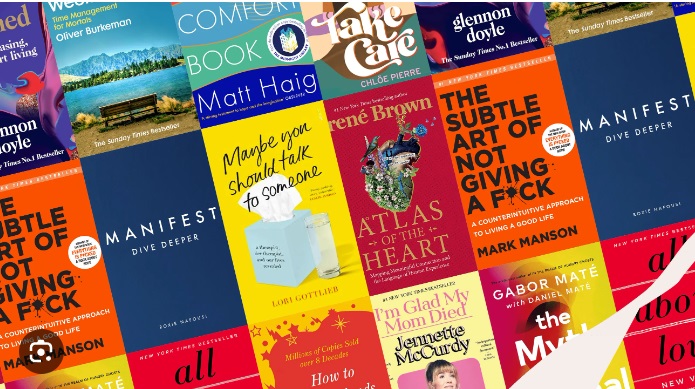
Do you rely on so-called “self-help” books to improve whatever it is you want to improve? About eight years ago I wrote about why I don’t think much of them and my unexpected reply to a college student who asked me following a speech I gave, what self-help book I would recommend to improve relationships with co-workers. It’s in the blog post to which I’ve linked.
Lately I started thinking about self-help books again for a couple of reasons. For one, while in a book store, I noticed they’re not called “self-help” books anymore, but rather less obtuse categories such as “self-improvement” or “life-improvement.”
Do those alternative categories soften the realization that one might need actual help in some area of their lives? If so, why is that necessary? There’s no shame in seeking help and we can all certainly stand to improve.
But it falls under a growing trend de-sensitize the truth. It sounds kinda harsh to say we need “help,” and clothing for larger folks is no longer labeled “plus sizes” but rather “comfort fit.” That’s fine. Self-esteem is important and I take no issue with attempts to help individuals feel better about themselves.
That leads to my main point. Self-help, or self-improvement, whichever you prefer, is much simpler than the myriad books and magazine articles make it seem. There’s no need to fill hundreds of pages with many thousands of words.
Self-help can be as simple as self-control. See? Two words.
Let’s take it further by drastically simplifying other subjects of bloated self-help books.
Marie Kondo has made a career with books and TV shows about organizing. I can boil organizing down to six words: “Throw things out. Put things away.” There. Simple.
How about leading a healthier life? So many millions of words blather on about this diet or that lifestyle. I’ll save you a lot of time with this word diet:
“Don’t eat crap. Get enough sleep. Get more exercise.”
Oh, I love the riot of rhetoric about how to get along better at work. This one is near and dear to me because I find workplaces can be one of the worst environments for spending the valuable time we have on Earth.
For this one I’m a little more expansive:
“Focus on your task. Be willing to listen more than speak at meetings. Don’t gossip. Ignore assholes. Office coffee is gross. Bring your own.”
I love the many books out there on how to negotiate—whether it’s a pay raise, business deal, price on a new car.
I’ll negotiate that issue thusly and succinctly:
“Know what you want. Know what you’ll accept. Don’t accept any less. Be willing to walk away.”
One of the more popular topics of self-help books is on relieving stress. I find plowing through hundreds of pages to find the answer is stressful, so I’ll pare it down to a less-stressful volume.
Big task ahead? “Break it down to its parts and complete one at a time rather than look at one big giant task ahead.”
Deadline? “No problem. When the deadline arrives you’re finished so you know you don’t have to live with the task beyond that. So stay focused, get it done, then relax.”
Bigger credit card bill than you can afford? “See what you can return. Pay it down over time. Learn the lesson and don’t do it again.”
See? I just boiled down five types of self-help books to a handful of words. Most of the help we need is not all that complicated and easy to understand if you don’t muck it up with pages and pages of blah, blah, blah.
Indeed, I’ll offer this brief self-help for would -be authors of future self-help books: “Keep it simple. Make it clear. Kill fewer trees.”
I’m telling you, we could shrink the self-help, or self-improvement, book store and library sections to maybe one shelf of single-sheets of concise advice.
It could work—so help me.
Our internal self-help book
 A few weeks ago I gave a presentation to a room full of Millennial MBA students who are aspiring management accountants. The subject was how to communicate across the generations in the workplace. My best advice was to work harder on creating a cogent message that anyone could understand, rather than drive yourself crazy wondering how to convey the same thought to a Baby Boomer, Generation Xer or Millennial. After all, if you’ve constructed a clear, simple communication that’s well focused, even a pony should understand.
What made me sad was a question I received asking what book would I recommend that could assist a young person in the workplace better communicate. A book? I abhor self-help books. Oh, they may offer some useful hints but as someone once said “there’s no manual for living life.” I believe that. I smiled at the young man and told him “you already have the book. Everyone has it. It’s in two volumes–your heart and your head.” Working in concert your heart and brain process a person’s personality, social cues, truthfulness, motives, attitude, aptitude, openness, aggressiveness or timidity. That process works both over time where you have had experiences with that person or have observed their behaviors, and in nanoseconds during a particular interaction. Using both “volumes” of your personal self-help book you can make informed decisions about how to approach or respond to another human being. I especially love the “chapter” on common sense.
By the time I finished my unexpected response, the student took a deep breath of relief, as did others in the audience of about 200. My questioner then smiled with a new air of confidence as he thanked me.
So much has been written about the self-absorption Millennials may display, but in their defense they were victimized by so-called helicopter parents who did everything but go to the toilet for them, although I’m sure one such parent may be working on a tandem toilet adapter they could use. They were not encouraged to leave the nest quickly after college and had little need to think for themselves.
In my presentation I urged managers and supervisors to counteract this learned neediness by simply treating young employees the same as more seasoned staff. Those who are mature and talented enough will snap out of their stupor and become valuable team members. Those who do not have the capacity to get beyond their hovering parents will fade.
But in the end, regardless of age or experience, if we all effectively refer to our internal two-volume self-help “book,” relying on our heart and head to guide us, or risk finding ourselves on the shelf.
 edLINES