Tagged: writing
Consulting Adults
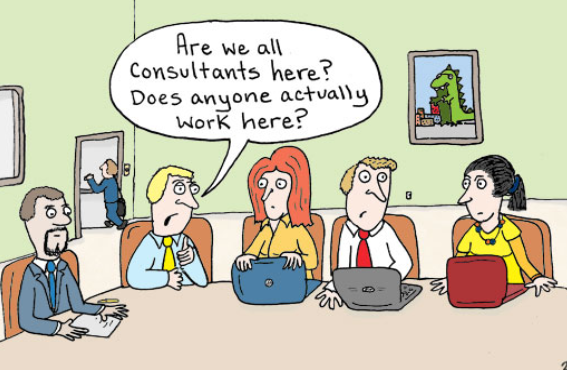
My first contact with a consultant came in 1979 at my first TV job. While attending grad school at the University of Arizona I landed a job as the weekend weather guy at the ABC affiliate in Tucson, KGUN.
I took to the job right away. After several years working as a morning drive time radio DJ, I was comfortable working without a script, ad libbing based on my map and information from the weather wire.
Our station was blessed with a great talent pool but crappy ratings, so they hired consultants based in Southfield, Michigan. The firm consisted of two former/failed news directors and an alleged “style” expert whose personal style was a cross between dust mop and tent maker.
I won’t waste a lot of words. They were crap. They had our main male anchor so self-conscious he actually wrote notes to himself onto the set: “Don’t over emote, don’t move your shoulders, don’t touch your pee-pee.” He added that last one in as a sign of rebellion.
They came after our elegant and talented main weathercaster imploring her to “act naturally.” When she protested that she WAS acting naturally, they told her to “act naturally another way.”
When it was my turn for consultant-certified scrutiny they seized on that fact that when only a little bit of rain was forecast, I would use the word “spritz.”
“Oh! That’s too eastern!” the consultants complained. I replied, “you mean too Jewish?” Busted. They looked at their shoes and moved onto my hair
Indeed, my viewers loved when I used that term and often joked with me when I was out in public, “hey Ed, is it gonna spritz today?” It was an everyday term back where I grew up in New York City, but a novelty in the desert southwest.
Turns out we dumped them because after two ratings periods under their “expert” guidance, our ratings actually fell even further.
What this whole prologue is leading to is I promised myself if I ever ended up as a consultant I could provide useful counsel based on my decades of experiences, while being sensitive to the company’s culture, goals and needs, not boilerplate nonsense.
So far, my two experiences consulting have mixed. In both cases I was told my experience would be valuable, helping staff improve their skills and opening the company’s eyes to new, or at least different angles for attacking certain issues.
After all, I built my reputation as a strong writing and producer covering thousands of stories as a reporter in radio, local TV, CNN, AP, Detroit News before jumping over to corporate PR.
During my 11 years at the various incarnations of Chrysler, I was known as a creative problem solver and innovator, pioneering the concept known as corporate journalism and introducing new methods and technologies, boosting the company’s exposure while saving it millions of dollars through efficiencies and bringing certain functions in-house.
Even before my last day on the job I was approached about lending my expertise to a news organization that was primarily print and online but contained a video element.
“You could teach us so much!” I was told.
Hmm. At first I was welcomed, but as time went on I detected several flaws in their TV production process and attempted to set them straight.
Oh! He’s gonna tell us we’ve been doing it wrong? Yeah. Change is hard. Doing it the same old way even if it’s wrong is easy. See ya, Ed!
The next one started more promising and lasted a few years until the company decided a consultant was really just a spare guy.
No…a consultant is not your spare writer, photographer, gofer, story pitcher. A consultant is there to advise and instruct your people already in those roles how to improve their performances or advise management on certain strategies.
What happens is people who are insecure, or perhaps in over their heads in their current roles, become very jealous and resentful of the outside consultant.
Honestly, consultants don’t want your job. We’re here just to help you do it better. If you can’t accept critique and instruction, perhaps you’re not mature or talented enough to remain in your position.
By no means are all consultants valuable or effective, as my experience back in Tucson attested.
If your company decides a consultant might be helpful, you need to really research the consultant’s track record of improvement, connect with current or former clients and then have that in-person conversation with the prospective advisor to see if it’s a good fit.
You also have to define the scope of work answering a few questions:
1-Why do you feel you need a consultant?
2-What skills and experiences does a consultant need to provide the counsel you seek?
3-How open is your corporate culture to accepting new ideas from outside the organization?
4-How will you prepare the staff for both scrutiny and direction from an outside source and why you feel it’s necessary?
Look, you don’t have to accept or adopt anything a consultant suggests, but by hiring one you’ve al least shown you’re open to examination, scrutiny and considering new ideas.
When it works, it’s a beautiful thing. When it doesn’t, admit it, don’t leave the consultant hanging. Be respectful, professional and courageous enough to end things decisively, informing the consultant why the engagement is ending.
Then you can both move on…without spritzing on each other’s parade.
How Calling Audibles Can Save Your Ass…and Your Kidney
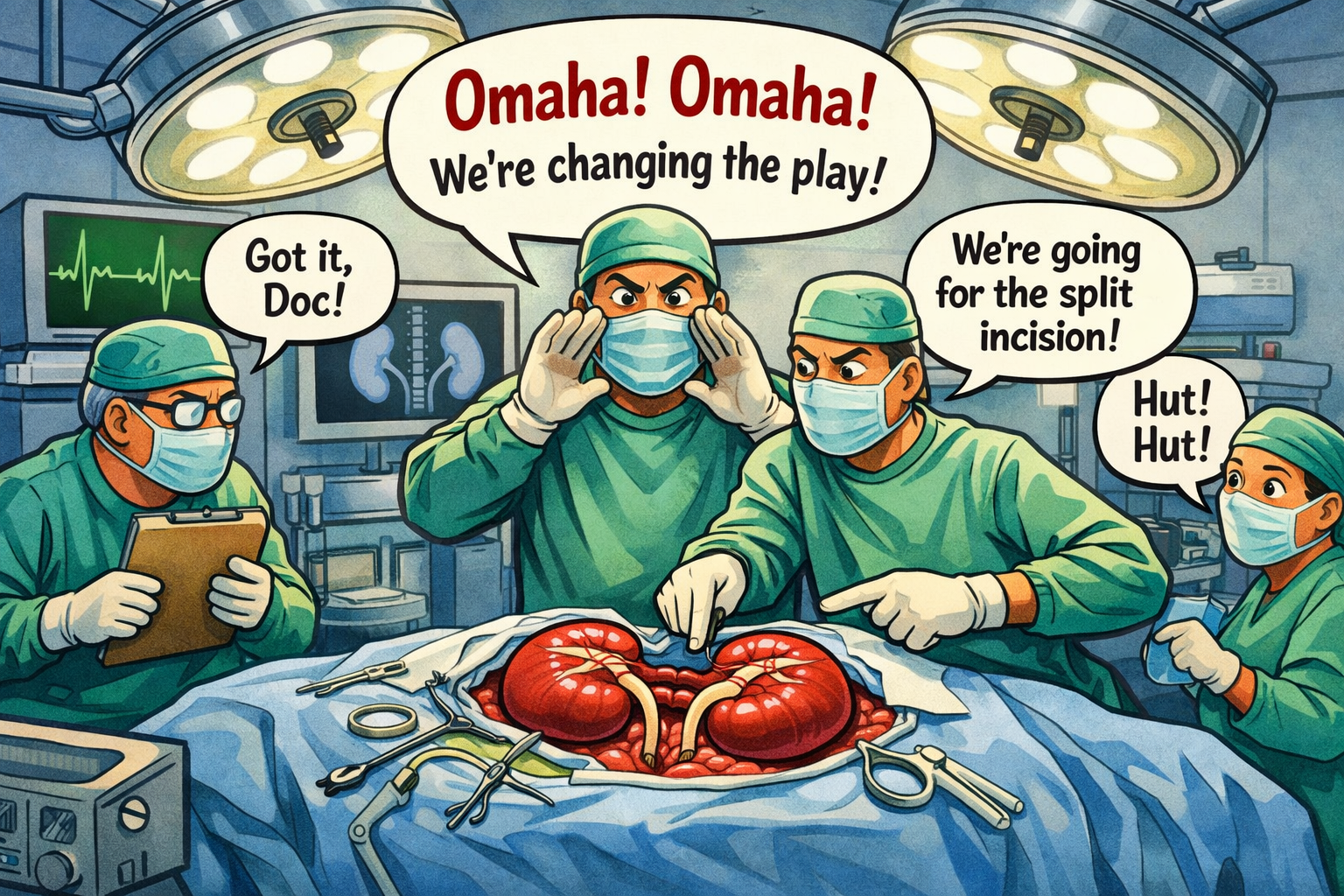
Ahead of Super Bowl Sunday, which coincides with my birthday, it seems like an appropriate time to discuss audibles…and my left kidney. Stay with me in the story below to understand the relationship and what lessons there are for all of us faced with those on-the-spot decision that can be the difference between a big gain or being thrown for a loss.
Last Friday a team of doctors, and robots, conducted what’s known as a pyeloplasty to repair a blockage where my left kidney empties into the ureter..one of two tubes on the wee-wee superhighway that sends the stuff to the bladder.
Such a blockage can basically reduce the kidney’s functionality to the point where it’s useless and must be removed. Who wants that? You start with two, you like to end with two.
In the simplest of terms, it’s a matter of snipping out the blockage, sewing together the truncated tube. Going into the procedure, which takes about three hours, based on a previous MRI the doc already knew there was a little complication. Looked like a tiny blood vessel had wormed its way onto the ureter causing the blockage. If they could move it, the full pyeloplasty might not be necessary.
Now skip ahead to the big game.
Imagine Seattle quarterback Sam Darnold peering over the scrimmage line at the Patriot’s defensive formation ahead of the snap. Crap. The planned play was a play action pass but the Pats are lined up in telltale blitz formation and the Seahawk’s O-line had been leaky thus far.
That would mean Darnold would have to get rid of the ball quickly before he’s swarmed, rather than drop back in a weak pocket for a pass.
Time to call an audible. Screw the pass, it’s now a quick handoff for a short gain. Better than being sacked for a loss.
That’s sort of what happened in operating room 2 last Friday. Just when the docs had their plan they noticed a cyst creeping up in the vicinity of the blockage. Getting to be a bit of a traffic jam in Ed’s tube!
According to my doc’s telling of the story they quickly called an audible in their sterile, hushed huddle.
It went something like this:
Doc 1: Shit…cyst !
Doc 2: OK…bust it!
Doc 1: Cyst busted! Now what?
Doc 2: Could still be a problem. Do the pyeloplasty anyway?
Docs 1 and 2 agree that would be the best strategy for a more permanent repair.
The quickly changed plan was successful.
Major gain.
Indeed, it seems like we’re faced with calling audibles all through life. We had a plan, or expectation but something came up at the last second and we need to instantaneously change our course of action.
Some people find the prospect of a quick pivot under pressure unnerving, or even impossible. They can’t possibly call an audible to change strategy because they’re not equipped do so.
What do they do? Often, they’ll panic, freeze, fail.
The reason my doctors, or a football quarterback, or anyone who must make quick decisions is able to call an audible under pressure with successful results is because of five major factors:
1-They anticipated more than one scenario going into the task
2-They planned in advance for all the possible scenarios
3-They communicated the possible alternative plans with team members or others responsible for completing the task.
4-They instantly leveraged training and experiences situations to help decide the best course of action.
5-They have the courage and confidence to make the call and see it through.
The lesson is never to go into a situation without flexibility, preparation, planning…and plans A,B, C or more.
You never know. Whether you’re quarterbacking the big game, complex project, or even fixing an old reporter’s faulty bodily plumbing, the ability to quickly call an audible on the spot can be the difference that results in gaining ground, hitting paydirt….saving a kidney.
44 Years Since CNN Took A Chance on Me
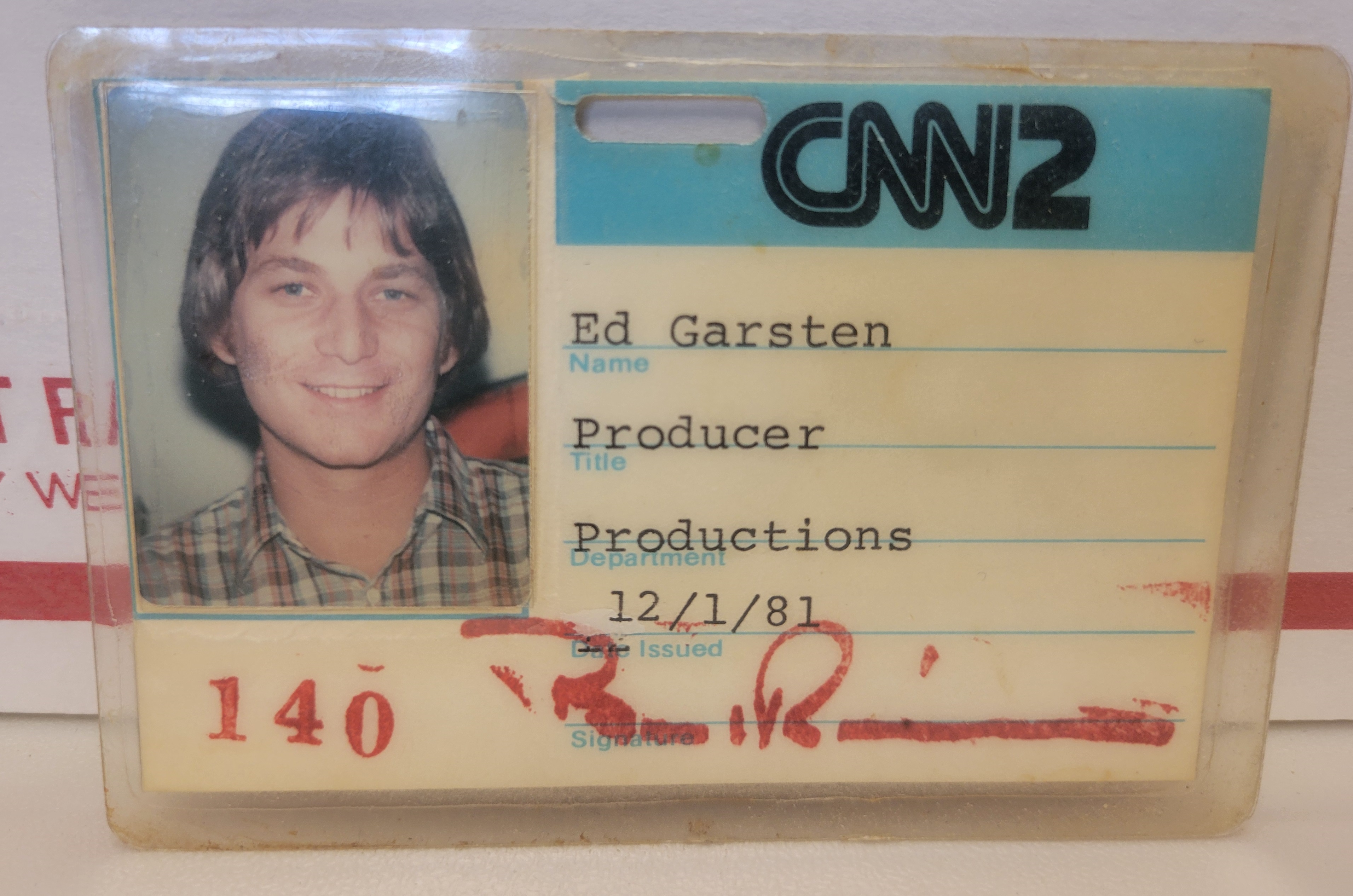
The ID badge is dated December 1, 1981 but November 30 was really my very first day at CNN, 44 long years ago.
It was a rainy day in Atlanta. I was alone in beautiful apartment with just a sleeping bag, air mattress, lawn chair, 19-inch TV and a cardboard box that served as table for eating, and some clothes. All my other stuff was in Tucson, Arizona, along with my wife, who flew back there to sell our little adobe block house. She was gone for three months, along with my stuff.
By the time our house was sold and my wife, and belongings and furniture arrived with her, that poor cardboard box was a greasy mess from its use as my dining room table/foot stool.
I was hired as one of the 10 original producers to launch the new network, CNN2, which eventually became Headline News.
If the bosses really knew how much experience I had producing television newscasts I’m sure they would have sent me on my way, but I fooled them with a kickass tape of my newscasts at KGUN, the ABC affiliate in Tucson.
You see, I joined the station doing weekend weather while I was a grad student at the University of Arizona, earning my Masters in Journalism. It was a way in. Within six months I was hired as a full-time reporter, which was my real goal.
That was going along fine when one day the news director called me in and said our longtime producer with 20 years experience had suddenly quit to take a job at a station in Phoenix and he’d love it if I took over.
Pretty funny. I’d never produced a TV newscast in my life.
“Oh, John will train you!”
He did. My first newscast after he left Ronald Reagan was shot. This was March, 1981.
CNN signed on June 1, 1980. I couldn’t watch it because our local cable system didn’t carry it, but I could catch little CNN news briefs on TBS, which was also part of the Turner Broadcast System.
One of the first anchors CNN hired was Lou Waters, who was the news director/anchor at our cross-town rival in Tucson, KOLD. He brought along his producer, Faye, who happened to be a great friend of our main weather caster Linda Rhodes, who formerly worked at KOLD.
That October, Linda tells me Faye tipped her off that CNN was starting a new network and needed producers. Was I interested? Uh, sure. Hell, I had a “solid” six months of experience. I was ready for the network!
I called the number Faye provided to Linda who gave it to me and next thing I know I’m on a flight to Atlanta on a Sunday. I was interviewed by every living body including the president of CNN at the time, Reese Schonfeld. We hit it off because I told him I worked at a radio station in Fulton, New York right out of college and damn, that’s where his wife was from!
I fly back to Tucson that evening with no expectations of landing the job, but the next morning, Burt Reinhardt, the top money man at the network, and successor to Schonfeld as CNN president calls me and offers me the job. Show up on November 30th.
I did, but it things got off to a clumsy start. Having worked in Arizona where no one gets dressed, I show up in a button down shirt, corduroy jeans and very comfortable shoes. Everyone else is in suits, ties, dresses and smirks, directed at me.
My boss, Ted Kavanau, a news legend from NYC, smiles, takes me aside and kindly mentioned, “as you can see we have a dress code.” Would have been nice to know in advance, but as I found out over the next 20 years, CNN was great at communicating news, just not important stuff to employees.
Ted told me to go over to the national assignment desk and ask one of the extremely busy people to explain how it worked.
I walk up to a bald guy with black-rimmed glasses and a beard and ask him the question. As he glares at my apparent insolence he barks, “you wanna know now the national desk works? Watch this!”
He then picks up the hotline to the DC bureau, starts screaming and swearing , then slams down the phone and quietly, but firmly, answers my original question with, “that’s how the fucking national desk works.”
When Ted asks me how it went I told him how my question was received. He kinda chuckled and said, “yeah, sounds about right.”
Welcome to network news.
I stayed at CNN2/Headline News for a little less than two years, producing hundreds of news casts in the most pressure-filled atmosphere you can imagine. Some producers actually broke down in tears under the pressure, others simply didn’t show up for work ever again.
In 1983 I was promoted to the main network to produce afternoon news casts, then promoted again to share producing the three hour morning show called Daybreak.
All this time, I would pick up a story here and there in hopes of moving back to reporting and by 1986 I was made a full time correspondent out of the Southeast Bureau based in Atlanta.
Here and there I would substitute anchor some newscasts and in 1989 the Detroit Bureau Chief/correspondent job opened. I tossed my tape into the ring and got the job. Been here in the Motor City ever since.
CNN dumped me and about 1,000 others during that “great” merger between parent company Time Warner and AOL in 2001, and closed the bureau.
We could have looked for work anywhere else in the country, but guess what, my family and I loved living in Michigan and I loved covering the auto industry.
Local TV wanted no part of me so I pursued print, because, let’s face it, I was never a TV star, but I could write. Best move I ever made.
It was funny, when I called someone at Ford for an interview while I freelanced for a short time at Automotive News.
“What? You write?” the guy at Ford asked. “TV guys can write?”
“Uh, yeah, I wrote every word that came out of my blow-dried head,” I replied.
“Heh,” he answered. “I thought producers wrote all that stuff for you guys.”
I had some great jobs in the print world. National Auto Writer at the AP, GM beat writer at The Detroit News, and in my semi-retirement, senior automotive contributor at Forbes.com.
But to come full circle, say what you want about what CNN has become, it opened a lot of doors for me when my time there ended there 25 years ago and still does.
The lesson I’d like to leave you all is don’t be afraid to step out of your comfort zone. Before I did the weather, I never did the weather, but I figured it out and succeeded. It led to dipping my feet into TV reporting. I sucked at first, but I received tough, but great direction from our photographers and news director.
I never produced a TV newscast but had a great teacher and got good enough to convince a network to hire me after only six months experience, and promoting me.
I never anchored a newscast when an executive at CNN saw something in me and gave me a chance. I solo anchored an hour network newscast with zero prior experience and it worked out, until the network president thought I looked a little too young. Tried to grow a beard, was too blonde..the lights washed it out.
When fate dealt me a blow I pivoted to print knowing I was a decent writer. Adjustments had to be made to transition from broadcast to print writing, but I was again lucky to have wonderful supervisors and editors to set me straight.
When I jumped to corporate PR at Chrysler, all the skills and news sense I had developed over the decades helped me succeed.
So if you’ve been laid off or otherwise “downsized,” just know you have skills that entirely transferrable and be willing to use them in different ways.
Take a chance, look beyond the obvious and usual. Not only will it help land a new gig, but it will open your life to new experiences and people and perspectives.
Most importantly, bet on yourself. The new stuff might seem challenging, scary, maybe even impossible, at first, but you know the chips in your stack.
Always, always, bet on yourself.
Refusing Role Call

I’m on Linkedin a lot to promote my Forbes.com stories and podcast, Tales From the Beat, so I see things. What I see are a ton of people who write they’re looking for “a new role.”
Of course these are unfortunate individuals who have found themselves suddenly payless because the thing they were doing to make a living was taken away from them due to firing, layoff, business failure or just bad luck.
It happened to me back in January, 2001 when I was laid off as part of the awesome merger between CNN parent company Time-Warner and AOL. I was the CNN Detroit bureau chief and correspondent at the time and was one of about 1,000 employees told to hit the road, thanks to the recommendations by an outside consultant.
So I’ve been there.
In my “role” as a father and husband I burned some of my generous severance to take my family on a vacation out to Arizona, then went to work…looking for work…a job.
The term “role” never entered my mind. I’m not an actor, although I act up some times. I actually was a speech and theater major in college until I realized I had no future as an actor because I couldn’t remember my lines. That’s one of the reasons I pivoted to broadcasting, because you get to read stuff instead of memorizing it.
But I’ve been thinking a lot about the wide use of the term “role” because, well, everyone has a role. Maybe you’re a partner, spouse, parent, mentor, individual pursuing life, support for a disabled person, confidante, conspirator. Those are all roles.
Folks, what you really need….is a job. It may not be as elegant a term as role, but it’s what you really seek.
You need a job because you don’t have one. You need a job because you need a source of income. You need a job because you enjoy working in your chosen field and it gives you pleasure, satisfaction and a sense of accomplishment.
Why do we need to use this word “role” to soften the message?
There is zero shame in admitting you need a job. There is no shame in admitting you need work. It’s what we all need unless you’re independently wealthy.
Coming out loud and clear that you’re in the job market is actually a great message. It tells prospective employers you’re ready to work and don’t mince words. Yup, no screwing around. “I need a job. I’m right for your company because I have all the skills, great employment record, list of accomplishments. I’ve thoroughly researched your company, its goals, its culture, its accomplishments and I bring qualities that will add value to the operation.
You’re not looking to play a role, you’re not looking to play at all. You’re looking to do a job and do it well in exchange for money.
Actors who play roles have understudies to step in when they can’t come to work. In real life, we don’t have the convenience of someone being paid to wait around backstage to do our jobs in case we don’t show up.
In my entire working 52 year working life, I never once said, “gotta head off to my role now!” I’ve never undergone “on the role training.”
I went to work. I underwent on the job training.
There’s no reason to substitute some sugar-coated euphemism to soften the message.
Just say what you mean. Use honest words to find honest work. You’ll always have your life’s role.
Simplifying Self-Help
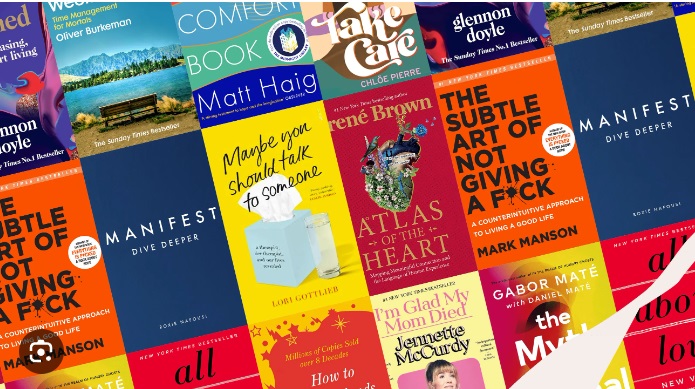
Do you rely on so-called “self-help” books to improve whatever it is you want to improve? About eight years ago I wrote about why I don’t think much of them and my unexpected reply to a college student who asked me following a speech I gave, what self-help book I would recommend to improve relationships with co-workers. It’s in the blog post to which I’ve linked.
Lately I started thinking about self-help books again for a couple of reasons. For one, while in a book store, I noticed they’re not called “self-help” books anymore, but rather less obtuse categories such as “self-improvement” or “life-improvement.”
Do those alternative categories soften the realization that one might need actual help in some area of their lives? If so, why is that necessary? There’s no shame in seeking help and we can all certainly stand to improve.
But it falls under a growing trend de-sensitize the truth. It sounds kinda harsh to say we need “help,” and clothing for larger folks is no longer labeled “plus sizes” but rather “comfort fit.” That’s fine. Self-esteem is important and I take no issue with attempts to help individuals feel better about themselves.
That leads to my main point. Self-help, or self-improvement, whichever you prefer, is much simpler than the myriad books and magazine articles make it seem. There’s no need to fill hundreds of pages with many thousands of words.
Self-help can be as simple as self-control. See? Two words.
Let’s take it further by drastically simplifying other subjects of bloated self-help books.
Marie Kondo has made a career with books and TV shows about organizing. I can boil organizing down to six words: “Throw things out. Put things away.” There. Simple.
How about leading a healthier life? So many millions of words blather on about this diet or that lifestyle. I’ll save you a lot of time with this word diet:
“Don’t eat crap. Get enough sleep. Get more exercise.”
Oh, I love the riot of rhetoric about how to get along better at work. This one is near and dear to me because I find workplaces can be one of the worst environments for spending the valuable time we have on Earth.
For this one I’m a little more expansive:
“Focus on your task. Be willing to listen more than speak at meetings. Don’t gossip. Ignore assholes. Office coffee is gross. Bring your own.”
I love the many books out there on how to negotiate—whether it’s a pay raise, business deal, price on a new car.
I’ll negotiate that issue thusly and succinctly:
“Know what you want. Know what you’ll accept. Don’t accept any less. Be willing to walk away.”
One of the more popular topics of self-help books is on relieving stress. I find plowing through hundreds of pages to find the answer is stressful, so I’ll pare it down to a less-stressful volume.
Big task ahead? “Break it down to its parts and complete one at a time rather than look at one big giant task ahead.”
Deadline? “No problem. When the deadline arrives you’re finished so you know you don’t have to live with the task beyond that. So stay focused, get it done, then relax.”
Bigger credit card bill than you can afford? “See what you can return. Pay it down over time. Learn the lesson and don’t do it again.”
See? I just boiled down five types of self-help books to a handful of words. Most of the help we need is not all that complicated and easy to understand if you don’t muck it up with pages and pages of blah, blah, blah.
Indeed, I’ll offer this brief self-help for would -be authors of future self-help books: “Keep it simple. Make it clear. Kill fewer trees.”
I’m telling you, we could shrink the self-help, or self-improvement, book store and library sections to maybe one shelf of single-sheets of concise advice.
It could work—so help me.
 edLINES