Office Christmas Party…Pooper
 It usually goes down like this. Bing! New email. Subject line: Company Holiday Party. Your mental reply for the RSVP demand, “oh shit.” It’s a Hobson’s Choice. Don’t go and the boss, HR drones, and the POS who wants your job will construe you are worthless malcontent who disavows Christmas, New Years, Hanukkah, office morale and teetering on the edge of tweeting negatively about Boxing Day.
Do go, and you subject yourself to stilted small talk, worked into a corner by the guy who has no friends but thinks you’re open to a relationship, handcuffed by your attempt to balance a drink, plate of bacon-wrapped rutabaga and mini parfaits while being forced into giving high-fives as a form of holiday greeting.
Can you tell I’m not a fan of the office holiday party? Oh, don’t get me wrong. I absolutely believe in going out to dinner or lunch or even just drinks with your immediate team as a way of celebrating the holidays and reveling in all the things you accomplished together.
Before I retired last July from Fiat Chrysler Automobiles, I made it a tradition to treat my team to a celebratory activity. Sometimes I bought them a meal. Other times it was a fun activity like bowling or curling, plus I’d spring for food. It was a personal gift to thank them for their hard work. Plus, honestly, if they performed well, it helped me make a better case for that big bonus. Did I say “big bonus?” Sorry, I just made myself reverse digestion.
The big company party is where I draw the line. Sure, there’s sometimes pretty good food and maybe even some booze, but it’s generally late in the day or completely after hours, and frankly, by about 3 p.m. each day, I’ve seen enough of everyone. Love ya…during work hours. Then I’m Fred Flintstone, hopping in my car singing “yabba dabba doo!” as I swing onto the freeway and realize that tomorrow I’ll have to re-learn everyone’s names.
Now don’t get me wrong. There are elements of the office holiday party I enjoy. It’s especially entertaining to watch the clutch of ass kissers in full pucker mode as they attack some boss they think will be receptive to all their verbal hickeys. We often place bets as to when the poor schlub will give the silent signal for a lackey to ring their cell phone and fake an “urgent” meeting as a means of escape. Then there are the office hot chick and hunky guy who seem to attract the attentions of the opposite gender who have been secretly taking cell phone photos of them from across the office and posting them in their health club lockers. Not wanting to make a scene in front of their peers and supervisors the hotties cool their jets while being hit on harder than a jockey’s whip on Seabiscuit. Of course, then there’s the guy playing Santa who’s costume not only bulges from his belly full of jelly, but an overflowing ostomy bag.
The truth is, I love the holidays, the customs, the music, the celebrations… and I appreciate the opportunities, friendships and rewards of the workplace. I also appreciate the attempt by bosses to spread some holiday cheer by tossing a little soiree’. It’s a nice gesture. Aw, OK…I’ll RSVP that I’ll attend. But don’t hold it against me when I give that silent signal.
Happy holidays everyone!
 On February 20, 1962 I was in second grade at P.S. 186 in the New York City borough of Queens. Our teacher, a bubbly little delight with curly, dark brown hair, Mrs. Kantor, rolled in a TV set and we watched John Glenn become the first American in space orbit.
 It happens every few years. Christmas and Hanukkah occur at the same time leaving families like mine with the vexing issue of how much surface space to grant each holiday’s symbols.
 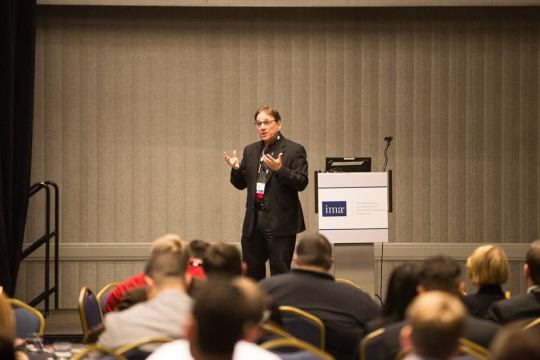 A few weeks ago I gave a presentation to a room full of Millennial MBA students who are aspiring management accountants. The subject was how to communicate across the generations in the workplace. My best advice was to work harder on creating a cogent message that anyone could understand, rather than drive yourself crazy wondering how to convey the same thought to a Baby Boomer, Generation Xer or Millennial. After all, if you’ve constructed a clear, simple communication that’s well focused, even a pony should understand.
 It didn’t hurt a bit. With a couple of clicks I deleted my Facebook account after roughly 6 years. I had a good time using it. It was a platform to crack some jokes, comment on the news, tell some personal stories, support my friends during tough times and promote my work. In the end, though, it was also a place to waste time and open myself up to, at times, unwanted contact.
 When we were kids in the 60’s we probably didn’t understand what a bad guy Fidel Castro was, although we knew he wasn’t our friend. Sometimes guys would dress up as him for Halloween, complete with military style ball cap, olive drab jacket, fake beard and bubblegum cigar.
 Then again, kids would sometimes imitate Nikita Khrushchev’s tantrum at the U.N. by donning bald wigs and rapping their shoes on their desks to get attention. Even though we were subjected to air raid drills and were taught where to find the nearest fallout shelter in case the Commies came after us, we tended to believe we were invincible and guys like Castro and Khrushchev were simply faraway villains that made for scary talk and useful Halloween costumes.
 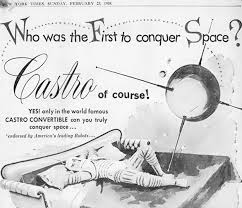 When Castro Convertible sofa beds started advertising we were really screwed up, thinking the Cuban despot had found a way to make a buck via our guest or living rooms. They’re still selling Castro Convertibles, but now it’s their unintended namesake who’s taking the big sleep…finally.
 Not as popular as New Years resolutions but more popular than anything on the CW Network, there are the annual lists of “what I’m thankful for” on the day those eating a nice slab of prime rib are thankful they’re not stuck with turkey.
 Could there be anything more mind-numbing than a long-winded speech or presentation punctuated with an endless Power Point deck where every slide contains every word the speaker just spoke? Oh, I use ’em, but try to make each slide a photo or some sort of graphic that supports what I’m saying, rather than parrot my patter. But sometimes fate steps in and has some mercy on your audience, pulling the plug on the Power Points…and then it’s time to tap dance.
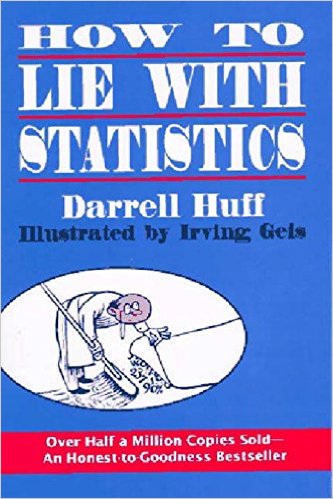 One of the best books I ever read was a slim little paperback thing published in 1954 titled “How to Lie With Statistics,” by Darrell Huff. It was required reading in my “Ethics in Journalism” course at the University of Arizona when I attended grad school there in 1978.
 Let me get this on the table right away. I’m a complete failure at masquerading.
