Our internal self-help book
 A few weeks ago I gave a presentation to a room full of Millennial MBA students who are aspiring management accountants. The subject was how to communicate across the generations in the workplace. My best advice was to work harder on creating a cogent message that anyone could understand, rather than drive yourself crazy wondering how to convey the same thought to a Baby Boomer, Generation Xer or Millennial. After all, if you’ve constructed a clear, simple communication that’s well focused, even a pony should understand.
What made me sad was a question I received asking what book would I recommend that could assist a young person in the workplace better communicate. A book? I abhor self-help books. Oh, they may offer some useful hints but as someone once said “there’s no manual for living life.” I believe that. I smiled at the young man and told him “you already have the book. Everyone has it. It’s in two volumes–your heart and your head.” Working in concert your heart and brain process a person’s personality, social cues, truthfulness, motives, attitude, aptitude, openness, aggressiveness or timidity. That process works both over time where you have had experiences with that person or have observed their behaviors, and in nanoseconds during a particular interaction. Using both “volumes” of your personal self-help book you can make informed decisions about how to approach or respond to another human being. I especially love the “chapter” on common sense.
By the time I finished my unexpected response, the student took a deep breath of relief, as did others in the audience of about 200. My questioner then smiled with a new air of confidence as he thanked me.
So much has been written about the self-absorption Millennials may display, but in their defense they were victimized by so-called helicopter parents who did everything but go to the toilet for them, although I’m sure one such parent may be working on a tandem toilet adapter they could use. They were not encouraged to leave the nest quickly after college and had little need to think for themselves.
In my presentation I urged managers and supervisors to counteract this learned neediness by simply treating young employees the same as more seasoned staff. Those who are mature and talented enough will snap out of their stupor and become valuable team members. Those who do not have the capacity to get beyond their hovering parents will fade.
But in the end, regardless of age or experience, if we all effectively refer to our internal two-volume self-help “book,” relying on our heart and head to guide us, or risk finding ourselves on the shelf.
 It didn’t hurt a bit. With a couple of clicks I deleted my Facebook account after roughly 6 years. I had a good time using it. It was a platform to crack some jokes, comment on the news, tell some personal stories, support my friends during tough times and promote my work. In the end, though, it was also a place to waste time and open myself up to, at times, unwanted contact.
 When we were kids in the 60’s we probably didn’t understand what a bad guy Fidel Castro was, although we knew he wasn’t our friend. Sometimes guys would dress up as him for Halloween, complete with military style ball cap, olive drab jacket, fake beard and bubblegum cigar.
 Then again, kids would sometimes imitate Nikita Khrushchev’s tantrum at the U.N. by donning bald wigs and rapping their shoes on their desks to get attention. Even though we were subjected to air raid drills and were taught where to find the nearest fallout shelter in case the Commies came after us, we tended to believe we were invincible and guys like Castro and Khrushchev were simply faraway villains that made for scary talk and useful Halloween costumes.
 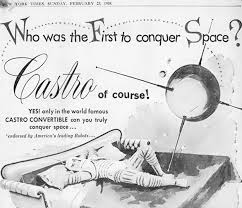 When Castro Convertible sofa beds started advertising we were really screwed up, thinking the Cuban despot had found a way to make a buck via our guest or living rooms. They’re still selling Castro Convertibles, but now it’s their unintended namesake who’s taking the big sleep…finally.
 Not as popular as New Years resolutions but more popular than anything on the CW Network, there are the annual lists of “what I’m thankful for” on the day those eating a nice slab of prime rib are thankful they’re not stuck with turkey.
 Could there be anything more mind-numbing than a long-winded speech or presentation punctuated with an endless Power Point deck where every slide contains every word the speaker just spoke? Oh, I use ’em, but try to make each slide a photo or some sort of graphic that supports what I’m saying, rather than parrot my patter. But sometimes fate steps in and has some mercy on your audience, pulling the plug on the Power Points…and then it’s time to tap dance.
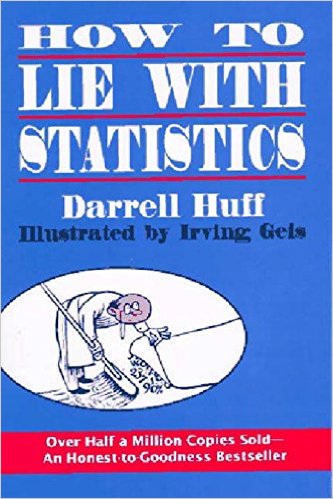 One of the best books I ever read was a slim little paperback thing published in 1954 titled “How to Lie With Statistics,” by Darrell Huff. It was required reading in my “Ethics in Journalism” course at the University of Arizona when I attended grad school there in 1978.
 Let me get this on the table right away. I’m a complete failure at masquerading.
 This is a photo of what I saw when I looked up from the book I was reading in the library today. That book was the latest silliness from Carl Hiaasen that opens with a woman who gets in a car accident because while she was driving she was shaving her, uh, girl area.
  Knowing Hiassen I’m convinced the book will evolve into something even more, um, entertaining, but looking at what was in front of me I felt a bit ashamed. A careful look at the selections of books on CD, and inst
 edLINES